Understanding Foundation Settling vs. Structural Damage in Texas
Reviewed by Mark Lee
If you have spent more than a single summer in the Lone Star State, you have likely heard a neighbor complain about their house "shifting." In Texas, foundation movement isn't just a possibility; it is almost an inevitability in Houston. However, not every crack in your drywall signifies a looming catastrophe. For many homeowners, the challenge lies in distinguishing between the natural aging process of a building and a structural failure that threatens the integrity of the home.
When you discover a gap above a door frame, your first instinct might be to panic and think, "I need to sell my house fast to a professional cash home buyer before the whole thing collapses." But before you call an investor or a repair crew, it is vital to understand the nuances of soil mechanics. Understanding the difference between minor settling and genuine structural damage can save you thousands of dollars in unnecessary repairs—or prevent you from ignoring a problem until it becomes a five-figure disaster.
The Physics of Foundation Settling: What is "Normal"?
Every house, whether it is a historic bungalow in the Houston Heights or a new build in a Katy subdivision, will experience settling. Settling is the process by which the weight of the structure causes the soil beneath it to compress.
Initial Compaction
When a house is first constructed, the weight of the concrete, lumber, brick, and roofing materials puts immense pressure on the ground. Over the first few years, the soil particles rearrange themselves into a more compact state. This usually results in a very slight, uniform downward movement of the entire structure. If the house moves evenly, you likely won't see any signs at all.
Minor Seasonal Movement
In Texas, settling is rarely a "one and done" event. Because our clay-rich soil is so reactive to moisture, your house may actually move up and down slightly with the seasons. During a rainy spring, the soil swells and lifts the edges of the slab; during a dry summer, the soil shrinks and the slab dips. This rhythmic movement can cause "hairline" cracks that open and close depending on the weather. In the eyes of a structural engineer, this is often considered "aesthetic" rather than "structural."
Defining Structural Damage: When Settling Goes Wrong
Structural damage occurs when the movement is no longer uniform. This is known as differential settlement. When one corner of your house sinks while the other remains stable—or heaves upward—the rigid concrete slab is subjected to "shear" forces. Concrete is incredibly strong under compression but very weak under tension. When the soil stops supporting a section of the slab, the concrete bends until it snaps.
The "One-Inch" Rule
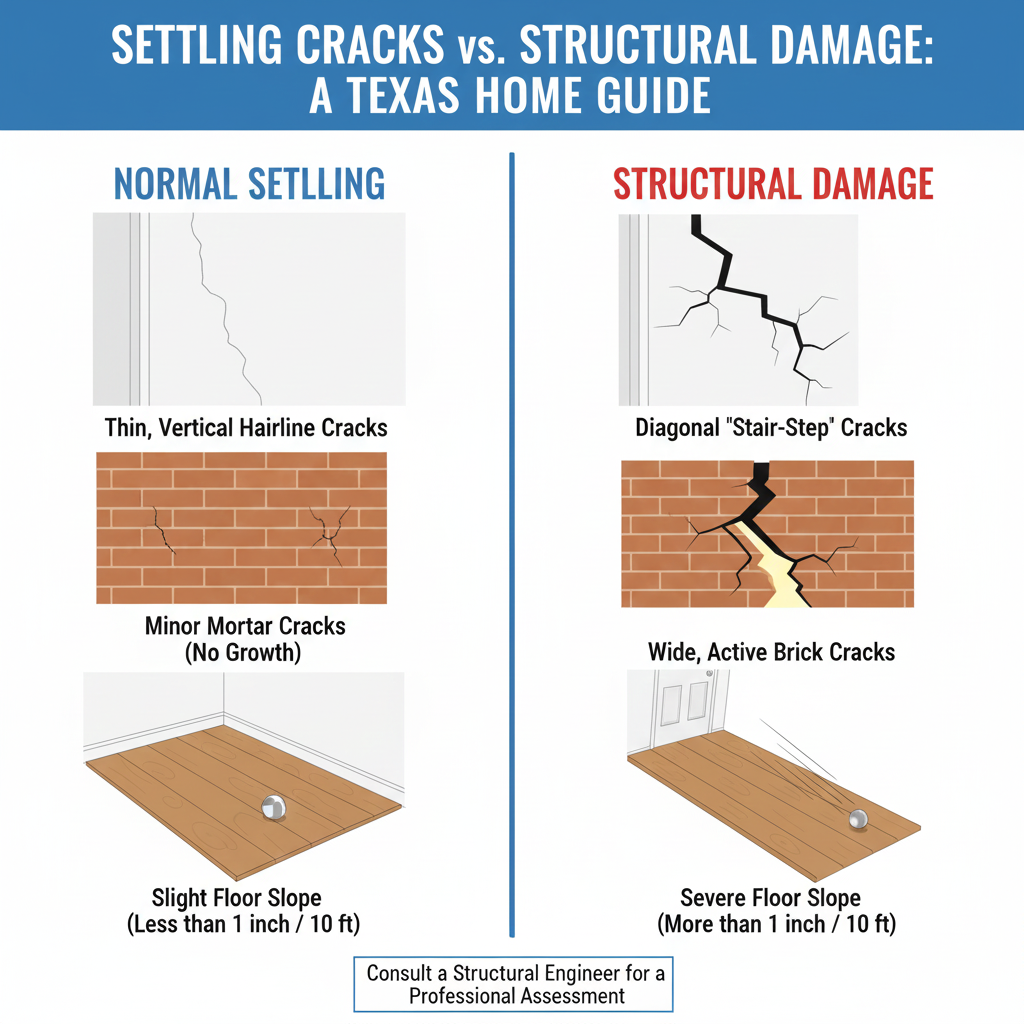
While every house is different, structural engineers often use specific measurements to define damage. If a floor slopes more than one inch over a ten-foot span, it is typically classified as a structural issue. Similarly, if a crack in a load-bearing beam or the foundation itself is wider than 1/4 of an inch, it has moved beyond the realm of "normal settling."
Compromised Load Paths
A house is a system of "load paths." The weight of the roof travels down the rafters, into the wall studs, and finally into the foundation. When structural damage occurs, these paths are interrupted. This can lead to sagging rooflines, leaning walls, and even a total collapse of certain structural members if left unaddressed for years.
Visual Cues: How to Tell the Difference
As a Senior SEO Content Strategist and Real Estate Expert, I always advise homeowners to look at the shape and direction of the cracks. The visual evidence is usually the most honest indicator of what is happening underground.
Signs of Normal Settling
Vertical Cracks: Thin cracks that run straight up and down in drywall or siding are often just signs of material expansion and contraction.
Hairline Cracks in Mortar: If you can’t fit the edge of a credit card into a crack in your exterior brick mortar, it is likely just settling.
Nail Pops: Small circular bumps in your drywall where a nail head is pushing through are common in new homes as the wood dries out and the house settles.
Signs of Genuine Structural Damage
Diagonal "Stair-Step" Cracks: These are the hallmark of structural failure. They look like a staircase moving up your brickwork or emanating from the corners of window headers.
Horizontal Foundation Cracks: If you see a horizontal crack in the concrete beam of your slab, it indicates that the foundation is bowing or "rolling" outward.
Door and Window Gaps: If a door is so crooked that you can see light through the top of the frame when it is closed, the frame is no longer square.
Separation of Add-Ons: If your chimney or a porch is visibly pulling away from the main body of the house, the two structures are settling at different rates.
The Role of Texas Soil in Structural Failure
The primary villain in this story is the "Houston Black" clay, also known as "Black Gumbo." According to the United States Department of Agriculture (USDA) Natural Resources Conservation Service, this soil is among the most expansive in the world.
The Shrink-Swell Cycle
Texas clay acts like a sponge. When it is wet, it expands with enough force to lift a 200,000-pound house. When it dries, it shrinks and cracks, leaving massive voids. If you have a large tree near your foundation, the problem is compounded. The tree's roots act as a pump, sucking the moisture out of the clay and causing localized "subsidence" (sinking). This is why you will often see foundation damage on only one side of a house—the side with the thirsty oak tree.
Poor Drainage and Soil Saturation
Conversely, if your gutters dump water directly at the base of your home, the soil becomes oversaturated. This "mushy" soil loses its load-bearing capacity, allowing the heavy concrete to sink into the mud. Proper drainage is the single most effective way to prevent settling from turning into structural damage. For more on Texas-specific soil standards, you can check the Texas Board of Professional Engineers.
Professional Evaluation: Why You Need an Engineer
If you are seeing the "red flag" signs mentioned above, your next step should not be calling a foundation repair company. You should hire an independent Structural Engineer (P.E.).
The Engineer vs. The Contractor
A foundation repair contractor is a salesperson. Their goal is to sell you piers. A structural engineer is a licensed professional who is legally bound to provide an unbiased assessment. They will use a digital manometer to create a "level map" of your entire home, showing exactly where the high and low points are.
The Engineering Report
An engineer's report is a powerful document. If the engineer says your house is just experiencing normal settling, you have peace of mind and a document to show future buyers. If they say you have structural damage, they will provide a "Plan of Repair" that tells the contractor exactly where to place the piers. This prevents you from overpaying for piers you don't actually need.
FAQ: Settling vs. Structural Damage
Can settling turn into structural damage later?
Yes. Settling is the "precursor." If a house settles unevenly and the movement continues unaddressed, it will eventually exceed the "flex" limit of the concrete slab, resulting in a structural break.
Does a "lifetime warranty" mean the house will never move again?
No. A foundation warranty typically only covers the specific piers that were installed. If the soil shifts in a different part of the house where no piers exist, you will have to pay for a new repair. This is why soil moisture maintenance is a lifelong commitment for Texas homeowners.
How much movement is allowed before it's "broken"?
Generally, the industry standard is that a slab should not deviate more than L/360. This is a mathematical formula used by engineers to determine if the "deflection" (bending) of the slab is within the safe limit for the materials used.
Should I repair cracks before an inspection?
If you are selling your home, never "patch and hide" cracks without a professional evaluation. Texas law requires a "Seller’s Disclosure," and hiding structural damage can lead to massive legal liabilities after the sale. If it's just settling, feel free to patch it. If it's structural, disclose the repair or the damage.
Will my insurance pay for structural damage?
Standard Texas homeowners policies usually exclude "earth movement." However, if a plumbing leak under the house caused the soil to wash away or swell, you might have a claim. Always have a plumber perform a "hydrostatic test" if you suspect a leak is the cause of your movement.
Summary: The Homeowner's Action Plan
Distinguishing between settling and structural damage requires a calm, methodical approach. To protect your home:
Log the Movement: Mark the end of a drywall crack with a pencil and date it. Check it again in three months to see if it has grown.
Maintain Moisture: Keep your soil at a consistent moisture level with soaker hoses to prevent the shrink-swell cycle from becoming extreme.
Check Drainage: Ensure your gutters are clear and the ground slopes away from your foundation.
Hire an Engineer: If you see diagonal cracks or sticking doors, spend the $500–$800 for an independent engineering report before talking to a repair company.
By staying informed and proactive, you can manage the unique challenges of Texas soil and ensure your home remains a stable, valuable asset for years to come.

How Absolute Properties Helps Houston Sellers
Absolute Properties makes it easy for Houston homeowners to sell fast - even when facing challenges like financial difficulties, inherited properties, troublesome tenants, or repairs.
If you’re thinking, “I need to sell my house fast in Houston…” We buy houses in Houston in any situation or condition!
As-is, fast cash offers with clear terms
Many closing costs covered; no realtor commissions in most cases
You choose the closing date (as little as 7 days, case-dependent)
Coordination with experienced title company for a compliant sale process
Call or text: (713) 230-8059
Email address: info@absolutepropertieshtx.com
Share your street address and timeline for a free consultation and a straightforward number no pressure.
Helpful Houston Blog Articles
How To Sell Your House in Houston Without Sinking Any More Money Into It
6 Tips For First Time Home Sellers in Houston
Hiring an Agent Vs. A Direct Sale to Absolute Properties When Selling Your House in Houston
Who Pays Closing Costs in Texas
The True Costs of An FSBO Listing for Houston Investors
What To Do With Your Expired Listing in Houston
Also check out our Free Guides & Education & FAQ for more education on how to sell your house for cash quickly to a local home buyer.