How to Add a Room to a House Cheap in Houston (5 Affordable Strategies)
Reviewed by Mark Lee
We’ve all been there. You wake up one morning, look around your home, and realize the walls are closing in on you. Maybe your family is growing, you suddenly need a dedicated home office that isn't the kitchen table, or you finally want a designated playroom so you stop stepping on Legos barefoot. When space gets impossibly tight, homeowners usually face a massive dilemma. You might be tempted to throw in the towel, pack up, and look to sell my house fast Houston just to escape the cramped quarters.
But with Houston real estate prices continuing to shift and mortgage rates doing their own unpredictable dance, moving isn't always the most financially savvy option. Sometimes, the best move is no move at all. Instead of packing boxes and dealing with closing costs, you can create the space you desperately need right where you are.
Building a brand-new, stick-built addition from the ground up can easily cost upwards of $50,000 to $100,000 depending on the finishes and square footage. Most of us don't have that kind of cash sitting around. Fortunately, you don't have to build a traditional extension to get more living space. If you get a little creative with the footprint you already have, you can expand your home without draining your savings account.
As a real estate expert who has seen hundreds of Texas floor plans, I’m going to walk you through how to add a room to a house cheap. Here are five highly affordable strategies that work beautifully for Houston homes.
1. The Classic Garage Conversion
When you need a substantial amount of square footage on a budget, look no further than your garage. In the Houston suburbs, two-car attached garages are standard issue. Converting this space is arguably the most cost-effective way to add a massive room to your house because the heavy lifting is already done.
Why It Saves You Money
Think about what makes traditional home additions so wildly expensive. You have to pour a new concrete foundation, frame the exterior walls, build a roof structure, and run new utilities. With a garage, the slab is already poured. The walls are framed and usually wrapped in siding or brick. The roof is completely finished. You are essentially taking a weather-tight shell and bringing it up to interior living standards.
The Houston Heat Factor
Turning a garage into a bedroom, home theater, or massive home office requires one major upgrade in Southeast Texas: serious climate control. Your garage was not built to keep out the August humidity. To make this space livable, you will need to invest in high-quality insulation. You must insulate the exterior walls, the ceiling, and ideally, you should insulate the garage door if you plan to leave it in place (though replacing the door with a framed wall and a window looks much more natural).
For cooling and heating, tying into your existing central HVAC system might overwork your current unit. Instead, consider installing a ductless mini-split system. These units are highly efficient, relatively affordable to install, and allow you to control the climate in the new room independently from the rest of the house.
Potential Drawbacks to Consider
Before you start framing, remember that a garage conversion eliminates your covered parking. In a car-centric city like Houston, this might be a sticking point for future buyers. Additionally, you will lose a significant amount of storage space for lawnmowers, holiday decorations, and tools. Finally, you absolutely must check with your Homeowners Association (HOA). Many strict Houston-area HOAs have covenants explicitly prohibiting garage conversions that alter the exterior look of the home.
2. Transforming the Attic into a Bonus Room
Because the soil in Southeast Texas is largely expansive clay and our water table is incredibly high, basements are basically a myth in Houston. So, if we can't build down, we have to look up. If you have a steeply pitched roof, you might have a goldmine of untapped square footage sitting right above your head.
Structural Requirements
Not all attics are created equal, and not all of them can be converted into living space. If your roof was built using "W" shaped trusses, converting the space will be incredibly difficult and expensive because those wooden webs are structurally necessary to hold the roof up. However, if your roof was built using traditional rafters (creating a large, open triangular space), you are in luck.
You will also need to assess the floor joists. The ceiling joists that hold up your drywall are rarely strong enough to support the weight of flooring, furniture, and people. You will likely need to sister new, thicker joists alongside the existing ones to create a structurally sound floor.
Managing the Texas Sun
If you’ve ever poked your head into a Houston attic in July, you know it feels like stepping into an active volcano. Radiant heat beats down on the roof shingles and turns the attic into an oven. To make this space comfortable, you need a multi-layered approach to insulation.
Spray foam insulation applied directly to the underside of the roof deck is often the best solution for attic conversions in our climate. It seals all air leaks and acts as a radiant barrier. You will also need to figure out an access point. Building a permanent staircase takes up square footage on the floor below, so you have to carefully plan where those stairs will go without ruining the flow of your existing layout.
3. Enclosing a Patio or Building a Sunroom
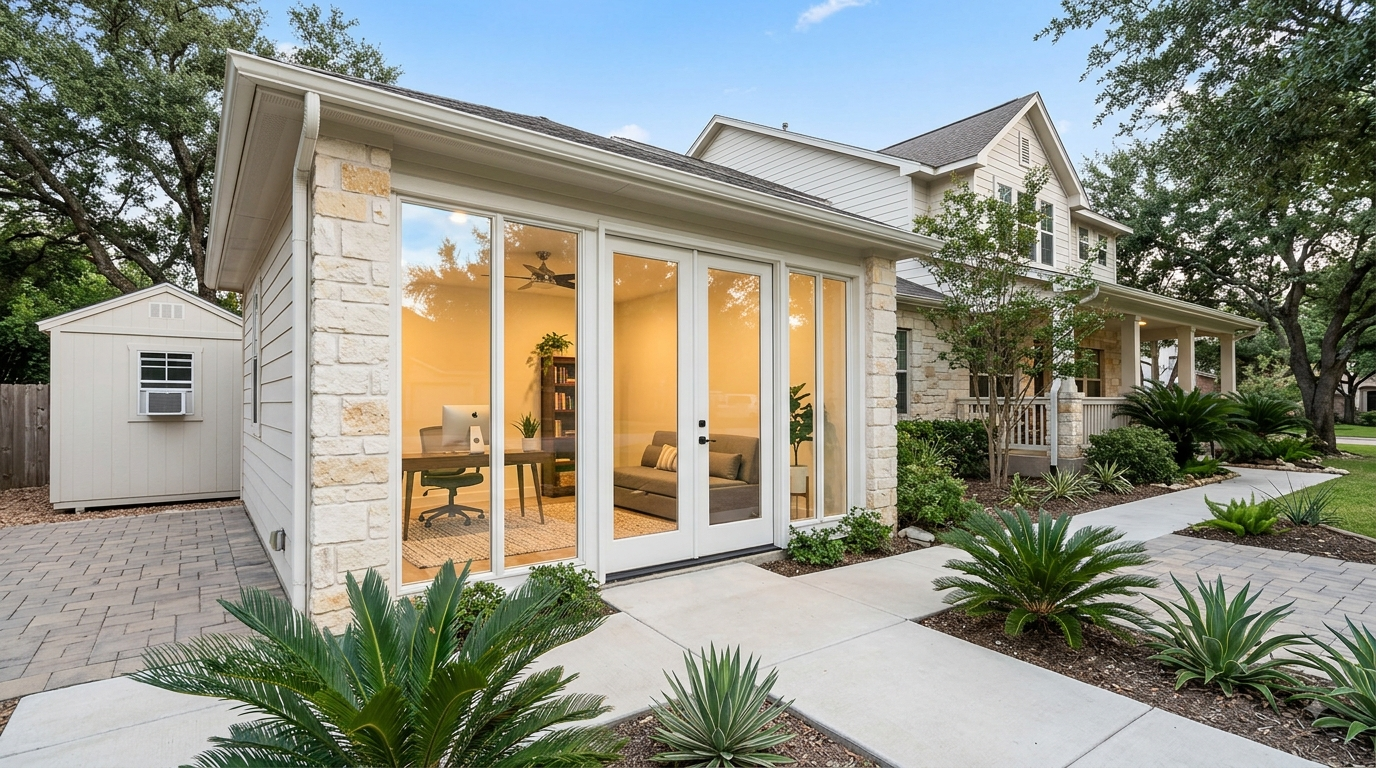
Texans love their outdoor living spaces. We love our covered patios, pergolas, and lanais. But let's be honest about the weather: for about four months out of the year, the mosquitoes and the oppressive humidity make sitting outside completely miserable. Enclosing an existing covered patio is a brilliant, budget-friendly way to add a multi-purpose room to your home.
Three-Season vs. Four-Season Rooms
When you decide to enclose a patio, you have two primary routes. A three-season room is typically enclosed with glass or heavy-duty screens, but it isn't fully insulated or tied into your home's permanent heating and cooling system. It's cheaper to build and perfect for spring, fall, and mild winter days.
A four-season room (often called a Texas room) is a fully insulated extension of your living space. You’ll use double-pane glass to block out the heat, insulated walls, and some form of climate control. While more expensive than a three-season enclosure, a four-season room actually adds to your home’s official gross living area, which boosts your property value.
Leveraging Your Existing Slab
Just like the garage conversion, the secret to the savings here is the foundation. If you already have a solid concrete patio slab that was poured properly (and isn't cracking or shifting severely), you have a foundation ready to build on. A contractor can frame walls directly onto the slab, install large panoramic windows to let in natural light, and seamlessly tie the new room's roofline into your existing eaves.
4. Dividing Existing Open Concept Spaces
If you want to know the absolute cheapest way to add a room to your house, this is it. You don't pour concrete. You don't alter the roof. You don't even add square footage to the footprint of the home. You simply repurpose the space you already have.
The End of the Mega-Room
During the late 90s and 2000s, builders in Houston suburbs like Katy, Sugar Land, and Cypress were obsessed with massive, open-concept floor plans and formal spaces. Many of these homes feature giant formal dining rooms right at the front entrance, or sprawling secondary living rooms that barely get used.
By framing a single non-load-bearing wall, adding some drywall, and hanging a door, you can instantly transform a dusty formal dining room into a private home office, a guest bedroom, or a nursery.
What You Need to Know About Framing a Wall
Building an interior partition wall is surprisingly inexpensive. The materials—wooden studs, drywall sheets, joint compound, screws, and paint—are cheap. Even if you hire a professional carpenter to frame the wall and hang the drywall, the labor costs are minimal because the job can usually be finished in two or three days.
If you want this new space to legally count as a "bedroom" when you eventually sell the house, you need to follow a few specific rules. Real estate standards generally require a bedroom to have a window that can be used for egress (escape in case of a fire) and a built-in closet. Framing a small reach-in closet at the same time you build the dividing wall will ensure you get the maximum return on your investment.
5. Prefabricated Sheds and Backyard ADUs
Sometimes, the best way to add a room to your house is to not attach it to your house at all. The rise of remote work has sparked a massive boom in backyard offices, "she sheds," and Accessory Dwelling Units (ADUs).
The Cost-Effectiveness of Prefab
Building an attached addition means navigating the complexities of tying a new structure into your old structure. You have to match roof pitches, blend the brick or siding, and carefully cut into your home's exterior. A detached prefabricated unit bypasses all of this headache.
Companies now manufacture high-quality, insulated, and modern-looking sheds that can be dropped right into your backyard. Because they are built in a factory setting, the construction costs are significantly lower than hiring a custom builder to frame something on site.
Customizing for Texas Weather
If you go the shed route, you can't just buy a raw plywood storage shed from a big box hardware store and throw a desk inside. You need a shed built for occupancy. This means it must be framed with standard studs so you can add fiberglass or foam insulation.
You will need to hire a licensed electrician to run power from your home’s main breaker box out to the shed safely. Once you have electricity, a simple window AC unit or a small mini-split will easily keep a 120-square-foot space freezing cold, even in the middle of a Houston heatwave.
While running electricity is fairly straightforward and affordable, running plumbing for a bathroom will drastically increase your costs. If your goal is strictly an office, an art studio, or a gym, skip the plumbing and save your money.
Crucial Considerations for Houston Homeowners
No matter which affordable strategy you choose to expand your living space, living in the Greater Houston area comes with its own unique set of rules and environmental challenges. You cannot skip the planning phase.
Navigating Permits and Red Tape
It is incredibly tempting to skip the permitting process, especially if you are just dividing an interior room or finishing out a garage. Do not make this mistake. If you ever want to sell your home, unpermitted additions can create a nightmare during the buyer’s inspection and appraisal process.
In Houston, almost all structural, electrical, and plumbing work requires a permit. If you live inside the city limits, you will deal with the City of Houston Permitting Center. If you live in the surrounding suburbs, you will need to check with Harris, Fort Bend, or Montgomery County, as well as your local municipal utility district (MUD). You can learn more about the permitting process by checking out the official Houston Permitting Center guidelines.
The Return on Investment (ROI)
Will adding this room increase your home's value? Generally, yes, but the return depends heavily on the type of room and the quality of the finish. According to industry data like the Remodeling Cost vs. Value Report, turning a non-livable space into a conditioned, livable square footage offers one of the best returns on investment. A beautifully executed attic or garage conversion can yield a 70% to 80% return when it’s time to sell.
However, the key word is quality. If an addition looks like a cheap afterthought—if the floors are uneven, the drywall seams are visible, or the room feels like an oven because of poor insulation—it can actually deter buyers. The new room needs to flow naturally with the rest of your home’s architecture.
FAQ: Adding a Room to Your House
Do I really need a permit for a backyard shed?
It depends entirely on the size of the shed and where you live. In many Houston-area municipalities, accessory structures under a certain square footage (often 120 to 200 square feet) do not require a building permit as long as they do not include plumbing or electrical wiring. However, if you are running power to it to create a home office, a permit and an electrical inspection are almost always required. Furthermore, your HOA will absolutely want to approve the design, height, and placement of the shed before you install it.
What is the absolute cheapest room to add?
The cheapest room to add is one that utilizes your existing footprint and requires zero structural changes to the foundation or roof. Therefore, putting up a drywall partition to split a large room into two smaller rooms is the cheapest option. If you need entirely new space, a simple three-season enclosed patio on an existing concrete slab is generally the next most affordable route.
Does an unpermitted addition add value to a home?
Usually, no. In fact, it can be a liability. When an appraiser evaluates your home for a buyer's mortgage lender, they will check the county tax records. If the county says your home is 2,000 square feet, but you have an unpermitted 400-square-foot garage conversion, the appraiser will often refuse to count that extra space in the home's official value. Worse, if the city finds out, they can force you to tear the work down or pay hefty fines to get retroactively permitted.
How much does it cost to condition a new space in Texas?
Because tapping into your existing central AC ductwork is often complicated and might overtax your unit, ductless mini-splits are the go-to solution for room additions. Depending on the size of the room and the brand of the unit, professionally installing a mini-split system in Houston typically ranges from $3,500 to $6,000. It is a worthwhile investment that keeps the new space comfortable year-round without skyrocketing your central energy bill.

How Absolute Properties Helps Houston Sellers
Absolute Properties makes it easy for Houston homeowners to sell fast - even when facing challenges like financial difficulties, inherited properties, troublesome tenants, or repairs.
If you’re thinking, “I need to sell my house fast in Houston…” We buy houses in Houston in any situation or condition!
As-is, fast cash offers with clear terms
Many closing costs covered; no realtor commissions in most cases
You choose the closing date (as little as 7 days, case-dependent)
Coordination with experienced title company for a compliant sale process
Call or text: (713) 230-8059
Email address: info@absolutepropertieshtx.com
Share your street address and timeline for a free consultation and a straightforward number no pressure.
Know someone else who needs to sell? We Also Pay a $1000 Referral Fee!
Helpful Houston Blog Articles
How To Sell Your House in Houston Without Sinking Any More Money Into It
6 Tips For First Time Home Sellers in Houston
Hiring an Agent Vs. A Direct Sale to Absolute Properties When Selling Your House in Houston
Who Pays Closing Costs in Texas
The True Costs of An FSBO Listing for Houston Investors
What To Do With Your Expired Listing in Houston
Also check out our Free Guides & Education & FAQ for more education on how to sell your house for cash quickly to a local home buyer.