What Is the 70% Rule in House Flipping? The Houston Investor’s Guide
Reviewed by Mark Lee
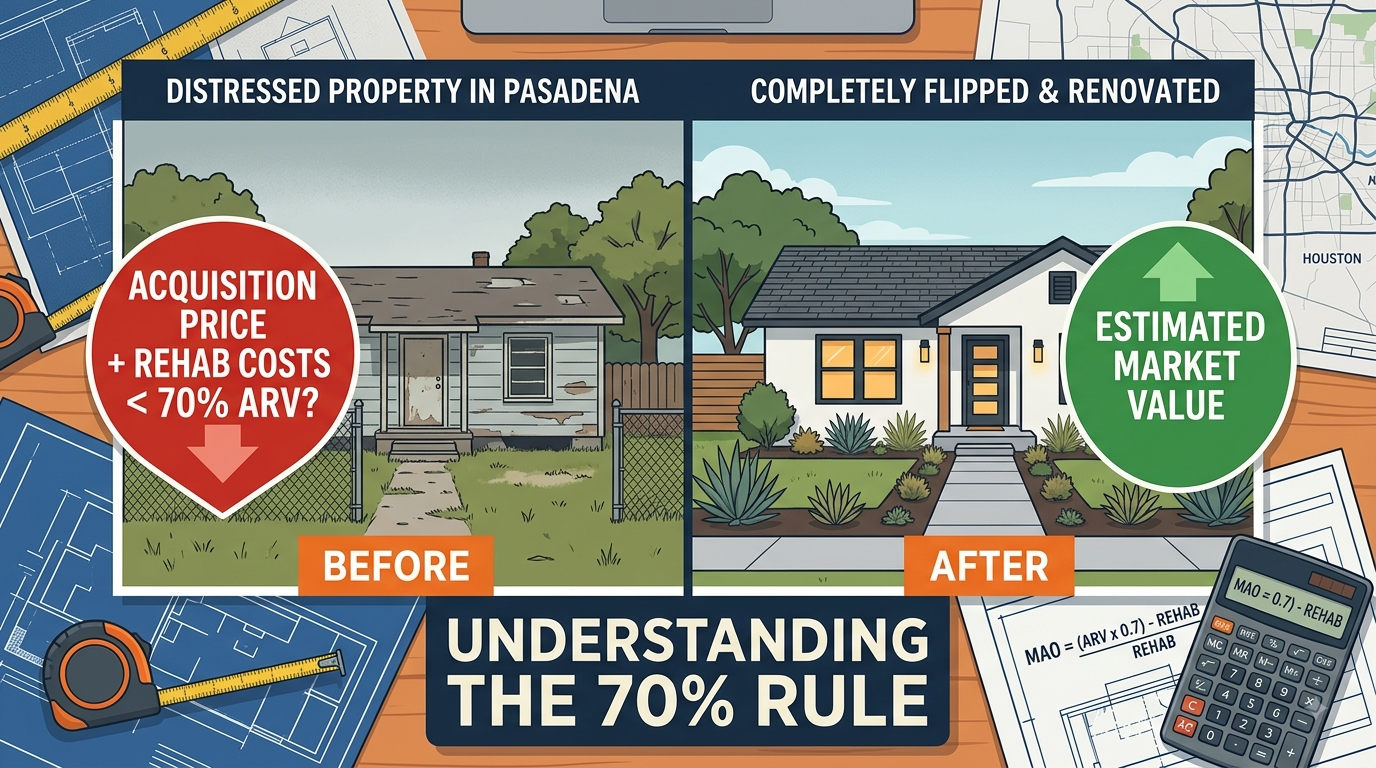
Flipping houses in the Houston real estate market can yield massive returns, but it can also drain your bank account fast if you run the wrong numbers. Whether you are hunting for distressed properties in Greater Fifth Ward, scouting mid-century fixers in Spring Branch, or analyzing deals in Pasadena, every successful flip hinges on a single fundamental calculation: the 70% Rule.
If you want to acquire distressed real estate, renovate efficiently, and exit with a healthy profit margin, you must master this foundational formula. Before making an offer or contacting Cash Home Buyers Houston to evaluate deal structures, understanding how the 70% Rule protects your downside risk in Texas is essential.
In this guide, we break down what the 70% Rule is, how to calculate it using real Houston market scenarios, where it falls short in today's high-interest environment, and how local investors adapt it to win deals without losing their shirt.
What Is the 70% Rule in Real Estate Flipping?
The 70% Rule is a quick-screening benchmark used by real estate investors, rehabbers, and wholesalers to determine the maximum purchase price they should pay for a distressed property.
At its core, the rule dictates that an investor should pay no more than 70% of the After Repair Value (ARV) minus the estimated cost of repairs.
The Core Formula
The mathematical formula for the 70% Rule is straightforward:
$$\text{Maximum Allowable Offer (MAO)} = (\text{ARV} \times 0.70) - \text{Estimated Repair Costs}$$
Where:
After Repair Value (ARV): The estimated fair market value of the home after all renovations, repairs, and updates are complete.
Estimated Repair Costs: The complete dollar amount required to bring the home up to target market standards (materials, labor, permits, and contractor fees).
Maximum Allowable Offer (MAO): The absolute ceiling price you can pay the seller while preserving an adequate profit cushion.
Why 70%?
The remaining 30% margin is not pure profit. Instead, that 30% gap accounts for three distinct operational buckets:
Closing & Acquisition Costs (3–5%): Title insurance, attorney fees, transfer fees, and escrow costs when buying and selling.
Holding Costs (5–10%): Property taxes (which are notably high in Harris County and surrounding Texas municipalities), insurance, utility bills, HOA dues, and hard money loan interest while the property is sitting vacant.
Investor Profit Margin (15–20%): The net return for taking on the financial risk and executing the rehab.
By baking these expenses into the initial formula, the 70% Rule prevents you from overpaying on purchase price, ensuring you do not run out of capital midway through construction.
Step-by-Step Breakdown: Calculating the 70% Rule in Houston
To truly understand how this rule functions on the ground in Texas, let's look at a realistic Houston flip scenario.
Step 1: Determine the After Repair Value (ARV)
Suppose you find a distressed ranch-style home in a desirable neighborhood like Oak Forest. You run a Comparative Market Analysis (CMA) looking at recently sold, fully renovated homes within a 0.5-mile radius over the last 90 to 180 days.
Target Property ARV: $400,000
Step 2: Estimate Construction and Renovation Costs
You bring a licensed general contractor to walk the property. The house needs a new roof, HVAC replacement, foundational leveling (extremely common due to Houston’s clay soil), a modern kitchen update, cosmetic bathroom upgrades, and exterior paint.
Estimated Repair Costs: $60,000
Step 3: Apply the 70% Formula
Now plug those figures into the MAO formula:
Multiply the ARV by 70%:
$$\$400,000 \times 0.70 = \$280,000$$
Subtract the repair costs from that subtotal:
$$\$280,000 - \$60,000 = \$220,000$$
Maximum Allowable Offer (MAO): $220,000
In this scenario, to keep your profit margin protected against unexpected delays or budget overruns, $220,000 is the highest price you should offer the seller.
Why the 70% Rule Matters Specifically for Texas & Houston Investors
While the 70% Rule provides a solid baseline across the country, local market dynamics in Houston demand special attention to certain variable expenses.
1. High Property Tax Rates in Harris County
Texas has no state income tax, which means local municipalities rely heavily on property taxes. Effective tax rates in the Greater Houston Area frequently range between 2.2% and 3.2% depending on the specific MUD (Municipal Utility District) and county. If a rehab project drags on for six to nine months, holding costs balloon rapidly due to property tax obligations.
2. Foundation Issues and Gulf Coast Weather
Houston soil contains high concentrations of expansive clay that contracts during dry summers and expands during wet rainy seasons. Foundation repairs are routine line items on flips here. Furthermore, severe weather events and tropical storms can unexpectedly halt construction schedules, driving up carrying costs. The 30% buffer accounts for these unexpected local line items.
3. Permitting Timelines and Municipal Code
Navigating the City of Houston’s permitting process can take longer than anticipated. Carrying hard money loan debt at 10% to 12% interest while waiting for plumbing or electrical inspections erodes profit margins every single day.
For deeper insights into local housing economics and historical real estate trends, you can review market metrics from the Texas Real Estate Research Center at Texas A&M University.
Limitations of the 70% Rule in Modern Markets
Although the 70% Rule is a great back-of-the-napkin screening tool, relying on it blindly can cause you to miss out on good deals or underprice complex projects.
Low-Priced vs. High-Priced Markets
The math behind the 70% Rule shifts depending on the price tier of the market:
Entry-Level/Low-End Homes ($100,000 ARV):
$100,000 \times 0.70 =$70,000.
If repairs are $30,000, your MAO is $40,000.
The 30% margin ($30,000) must cover all closing fees, taxes, and profits. On lower-priced homes, fixed costs take up a much larger percentage, leaving very little room for actual dollar profit. Many investors raise their threshold to an 80% rule for higher-end areas, but might drop to 60–65% for lower-priced, high-risk deals.
Luxury/High-End Homes ($1,000,000 ARV):
$1,000,000 \times 0.70 =$700,000.
A 30% spread equals $300,000. Even after subtracting high closing costs and carrying charges, the dollar profit is substantial. In competitive, high-end markets like the Heights or River Oaks, investors often operate on a 75% to 80% rule because they can afford smaller percentage margins due to higher absolute returns.
Material and Labor Inflation
Renovation costs fluctuate wildly based on supply chain dynamics and labor availability. If contractor quotes spike mid-project, a rigid 70% calculation executed months prior might prove inaccurate. Always add a 10–15% contingency line item directly into your renovation budget before running your final MAO.
How to Adjust the 70% Rule to Win Deals in Houston
In a competitive market where off-market inventory is tight, strictly sticking to the 70% Rule can mean getting outbid constantly by other cash buyers. Here is how experienced local flippers adapt the rule without taking on unmanageable risk:
1. Adjust the Percentage Based on Exit Strategy
If you plan to execute a BRRRR strategy (Buy, Rehab, Rent, Refinance, Repeat) rather than a quick fix-and-flip, you might adjust your target threshold to 75% or 80%. Since you intend to hold the asset for long-term rental income rather than paying double closing costs on a resale, your holding and transaction expenses drop considerably.
2. Micro-Analyze Holding Costs Separately
Rather than relying on the broad 30% lump sum to cover everything, build an explicit line-item holding sheet. Calculate exact monthly debt service, property taxes, insurance, and utilities. If you can complete a cosmetic flip in 45 days instead of 6 months, your actual carrying costs drop, allowing you to pay slightly more for the property upfront while keeping your net profit intact.
3. Source Off-Market Properties
Finding deals directly from motivated sellers allows you to eliminate realtor commission fees on the acquisition side. You can explore broader national market patterns and inventory metrics via National Association of Realtors Research to evaluate how local inventory constraints impact acquisition margins.
Frequently Asked Questions (FAQ)
What is the difference between ARV and market value?
Market value is what a property is worth in its current "as-is" condition today. After Repair Value (ARV) is the estimated value of the property after all planned renovations and upgrades are completed to match the condition of top-tier comparable sales in the surrounding neighborhood.
Does the 70% Rule include closing costs?
Yes. The 30% margin between the MAO and the ARV is designed to cover closing costs (both on purchase and resale), holding costs (taxes, insurance, utilities, loan interest), and investor net profit.
Can I use the 70% Rule for rental properties?
While designed primarily for house flipping, the 70% Rule is also used by BRRRR investors to ensure they leave little to no capital trapped in a rental property after cash-out refinancing. Most commercial lenders will refinance up to 75% of the new appraised value, making the 70% to 75% benchmark ideal for buy-and-hold deals.
What happens if repair costs exceed my budget?
If rehab costs overrun your estimates, your net profit margin shrinks dollar-for-dollar. This is why experienced investors include a 10% to 15% contingency buffer inside their initial repair cost estimate before subtracting it from the 70% ARV calculation.
Is the 70% Rule still realistic in today's housing market?
It depends on the sub-market. In tight, competitive areas, flippers often accept a 75% or 80% rule on higher-priced homes where fixed profit amounts remain strong. However, in higher-risk neighborhoods or on heavy structural rehabs, sticking strictly to 70% (or even 65%) remains critical to surviving unexpected project overruns.

How Absolute Properties Helps Houston Sellers
Absolute Properties makes it easy for Houston homeowners to sell fast - even when facing challenges like financial difficulties, inherited properties, troublesome tenants, or repairs.
If you’re thinking, “I need to sell my house fast in Houston…” We buy houses in Houston in any situation or condition!
As-is, fast cash offers with clear terms
Many closing costs covered; no realtor commissions in most cases
You choose the closing date (as little as 7 days, case-dependent)
Coordination with experienced title company for a compliant sale process
Call or text: (713) 230-8059
Email address: info@absolutepropertieshtx.com
Share your street address and timeline for a free consultation and a straightforward number no pressure.
Know someone else who needs to sell? We Also Pay a $1000 Referral Fee!
Helpful Houston Blog Articles
How To Sell Your House in Houston Without Sinking Any More Money Into It
6 Tips For First Time Home Sellers in Houston
Hiring an Agent Vs. A Direct Sale to Absolute Properties When Selling Your House in Houston
Who Pays Closing Costs in Texas
The True Costs of An FSBO Listing for Houston Investors
What To Do With Your Expired Listing in Houston
Also check out our Free Guides & Education & FAQ for more education on how to sell your house for cash quickly to a local home buyer.