Reviewed by Mark Lee
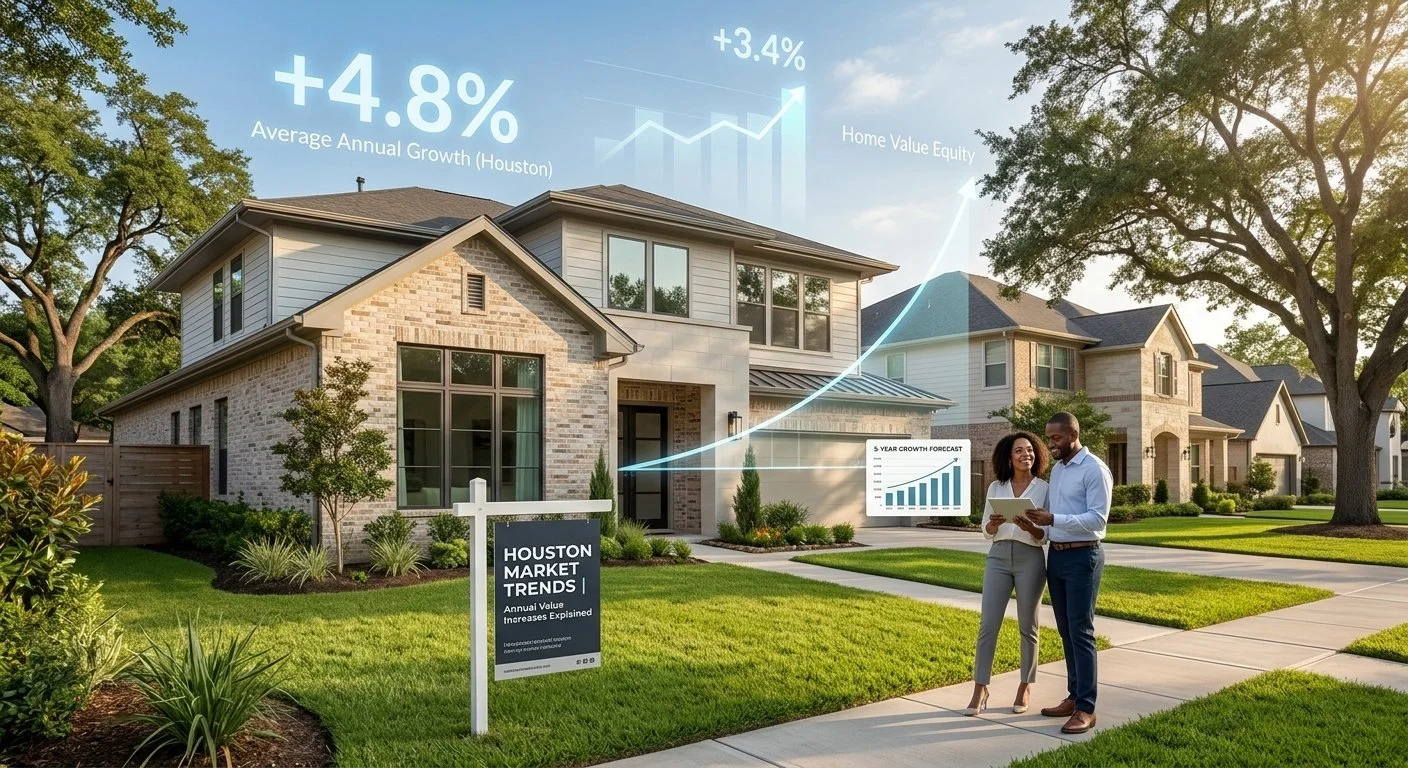
If you've spent any time tracking real estate trends, you’ve probably asked yourself: How much does a house actually go up in value each year? Whether you're eyeing a neighborhood inside the Loop, tracking suburban expansion, or looking to cash out, understanding appreciation numbers is critical. If you need to sell quickly or deal with an unwanted property, working with reliable Cash Home Buyers Houston can offer a straightforward path forward while saving you from costly repairs.
Across the United States, historical real estate data shows that residential property values appreciate by roughly 3% to 5% annually under normal market conditions. However, Texas—and specifically the Greater Houston metropolitan area—follows its own unique economic rhythm. Driven by persistent job migration, population expansion, dynamic energy markets, and expansive land availability, understanding real estate gains in Space City requires a closer look at regional micro-markets and local tax dynamics.
Let’s unpack the real metrics behind home value gains, evaluate historical Texas averages, and examine what these numbers mean for your property equity today.
The Baseline: What Is the Standard Annual Appreciation Rate?
To evaluate local real estate performance, we must first establish a national baseline. Real estate isn't a get-rich-quick instrument; it is a compound wealth builder. Over multi-decade cycles, single-family home prices generally outpace inflation.
National Averages vs. Local Texas Realities
Historically, national housing data compiled over 30 to 50 years demonstrates an average annual appreciation rate of approximately 4.2% to 4.7%. During periods of moderate inflation and stable interest rates, home values generally match or slightly outpace broader consumer price growth.
However, state-level performance varies dramatically. Texas consistently outperforms national volatility baselines due to several structural advantages:
No State Income Tax: Texas remains an attractive destination for high earners and relocating corporations, preserving consumer purchasing power.
Pro-Business Environment: Corporate relocations bring strong employment growth, maintaining steady housing demand across major hubs like Houston, Dallas-Fort Worth, and Austin.
Demographic Tailwinds: Rapid population expansion fuels continuous housing consumption, preventing deep price contractions during national cooling periods.
Houston Housing Market Dynamics: Real Estate Growth Breakdown
When zooming in on the Greater Houston area—including Harris, Fort Bend, Montgomery, and Brazoria counties—the historic average annual home value increase ranges between 3.8% and 5.2%. While localized surges during extreme market cycles saw annual jumps above 10% to 15%, long-term historical trends favor a steady, sustainable compounding rate.
Macro Factors Driving Space City Appreciation
Houston's real estate trajectory relies on several core economic engines that keep property values moving upward over time:
Job Diversity and Economic Migration: Houston has successfully expanded beyond its traditional oil and gas footprint. Today, the world-class Texas Medical Center, tech corridors, renewable energy expansion, and the Port of Houston attract thousands of new residents annually, driving sustained demand for housing.
Affordability Relative to Coastal Metros: Compared to Los Angeles, New York, or San Francisco, Houston offers significantly higher square footage per dollar. This affordability cushion gives local home values substantial headroom for long-term growth.
Flexible Zoning and Suburban Growth: Unincorporated Harris County and surrounding municipalities leverage master-planned communities to absorb population influxes. While flexible construction keeps price spikes in check compared to land-constrained coastal cities, demand for established, well-located neighborhoods continues to drive solid long-term appreciation.
Key Drivers That Dictate Your Home’s Yearly Appreciation
Not every neighborhood in Texas gains value at the same velocity. While citywide or countywide averages provide a macro benchmark, several micro-level factors dictate your individual property's yearly equity gains.
1. Location and School District Quality
In the Houston market, micro-location often supersedes broader regional trends. Neighborhoods tied to highly rated public school systems—such as Katy ISD, Clear Creek ISD, or select areas within Spring Branch ISD—historically command higher appreciation premiums. Homes located inside the I-610 Loop (like the Heights, Montrose, and River Oaks) enjoy structural land scarcity, driving robust long-term equity growth.
2. Upgrades, Maintenance, and Capital Improvements
A home's appreciation rate reflects both market-wide inflation and physical condition. Deferred maintenance—such as an aging roof, foundation movement, or outdated HVAC equipment—can drag a home's actual equity growth well below neighborhood averages. Conversely, smart modernization projects yield tangible returns:
Kitchen Modernization: Updating cabinetry, quartz counters, and energy-efficient appliances.
Primary Bath Upgrades: Walk-in showers and modern fixtures.
Essential Infrastructure: Replacing a 15-year-old roof or installing storm shutters and generator hookups.
3. Hyper-Local Supply and Demand Imbalances
Appreciation accelerated sharply when inventory fell below a 2-month supply during high-demand cycles. As regional inventory normalizes toward a balanced market (typically 4 to 6 months of supply), annual value growth naturally adjusts toward historic averages of 3% to 5%.
Historical Appreciation Rates vs. Inflation: Real Returns Unpacked
To appreciate the true value of homeownership, we must separate nominal equity gains from real inflation-adjusted equity.
If your home increases in value by 5% in a given year, but national consumer inflation sits at 3%, your real net appreciation gain is approximately 2%. However, leveraged real estate significantly amplifies these figures through equity compounding.
The Power of Financial Leverage
When purchasing a home, you rarely pay 100% cash upfront. Consider this scenario:
Purchase Price: $300,000
Down Payment (20%): $60,000
Annual Appreciation (4%): $12,000 gain in Year 1
Because your initial cash layout was $60,000, that $12,000 first-year value gain represents a 20% return on invested cash, ignoring principal reduction from monthly mortgage payments. This structural advantage makes residential real estate one of the most reliable long-term wealth generators available to Texas homeowners.
Calculating Your Home Equity Growth Potential
To track your property's performance against broader market benchmarks, you can use a simple compounding appreciation formula.
THE ANNUAL APPRECIATION FORMULA
Future Value = Current Value × (1 + r)n
Where:
- r = Estimated annual appreciation rate (expressed as a decimal, e.g., 0.045 for 4.5%)
- n = Number of holding years
PROJECTED EQUITY GROWTH ON A $350,000 HOUSTON HOME
Using an illustrative 4.0% annual appreciation rate, here is how a $350,000 home could grow in value over a 10-year holding period.
| Year Holding | Projected Home Value | Cumulative Equity Gain |
|---|---|---|
| Purchase (Year 0) | $350,000 | $0 |
| Year 1 | $364,000 | $14,000 |
| Year 3 | $393,702 | $43,702 |
| Year 5 | $425,828 | $75,828 |
| Year 7 | $460,575 | $110,575 |
| Year 10 | $518,086 | $168,086 |
Note: This projection assumes a constant 4.0% annual appreciation rate and excludes mortgage principal payoff, transaction costs, and market fluctuations. Actual results will vary.
What Texas Homeowners Need to Watch: Property Taxes & Maintenance Costs
While rising home values build wealth on paper, Texas homeowners face specific holding costs that impact real net returns.
Navigating Texas Property Taxes
Unlike states with heavy income taxation, Texas relies heavily on ad valorem property taxes to fund municipal services, infrastructure, and public schools. With effective property tax rates across Harris and Fort Bend counties often ranging between 1.8% and 2.6%, rapid appreciation increases annual tax assessments.
Homestead Exemptions: Texas homeowners should always file a General Residence Homestead Exemption on their primary residence. This caps annual assessed value increases for tax purposes at 10% per year, protecting owners from severe tax spikes during rapid market surges.
Protesting Assessed Values: Regularly challenging annual county appraisal values (such as those from HCAD) ensures your tax burden doesn't outpace actual property market conditions.
Factor in Home Maintenance and Capital Reserves
To capture top-tier appreciation rates when selling, budget approximately 1% of your home's total value annually for routine repairs and ongoing upkeep. Protecting major components—like foundations, plumbing systems, and roofs—preserves structural equity over time.
Frequently Asked Questions (FAQ)
What is the average home value increase per year in Texas?
Historically, home values across Texas increase by an average of 4% to 5.5% annually. While specific metropolitan areas like Austin, Dallas-Fort Worth, and Houston experience cyclical swings, long-term state averages consistently keep pace with or slightly exceed national benchmarks.
How do I figure out my specific home’s appreciation rate?
To calculate your personal rate, subtract your original purchase price from your current estimated market value. Divide that difference by your original purchase price to get total percentage growth, then divide by the number of years you've owned the property to determine your simple annual appreciation rate.
Is home appreciation guaranteed every year?
No. Real estate operates in natural economic cycles. While multi-decade trends lean strongly positive, individual years can see flat pricing or modest pullbacks due to shifting mortgage interest rates, broader economic contractions, or localized inventory surpluses.
Do home upgrades increase appreciation faster than market trends?
Selected strategic renovations can boost your home's appraisal value above baseline market growth. Kitchen remodels, bathroom modernizations, and square footage expansions generally offer high value retention, though simple ongoing maintenance remains critical for preserving baseline appreciation.
How does inflation affect annual home value gains?
Housing values generally rise during inflationary periods because building materials, labor, and land costs become more expensive. This supply-side pressure pushes up prices for existing housing stock, helping homeowners preserve real purchasing power.
External References & Data Sources
For national real estate statistics and economic indicators, review the Federal Reserve Bank of St. Louis Economic Data (FRED).
To inspect local housing statistics and market updates across the Greater Houston area, visit the Houston Association of REALTORS® (HAR).

How Absolute Properties Helps Houston Sellers
Absolute Properties makes it easy for Houston homeowners to sell fast - even when facing challenges like financial difficulties, inherited properties, troublesome tenants, or repairs.
If you’re thinking, “I need to sell my house fast in Houston…” We buy houses in Houston in any situation or condition!
As-is, fast cash offers with clear terms
Many closing costs covered; no realtor commissions in most cases
You choose the closing date (as little as 7 days, case-dependent)
Coordination with experienced title company for a compliant sale process
Call or text: (713) 230-8059
Email address: info@absolutepropertieshtx.com
Share your street address and timeline for a free consultation and a straightforward number no pressure.
Know someone else who needs to sell? We Also Pay a $1000 Referral Fee!
Helpful Houston Blog Articles
How To Sell Your House in Houston Without Sinking Any More Money Into It
6 Tips For First Time Home Sellers in Houston
Hiring an Agent Vs. A Direct Sale to Absolute Properties When Selling Your House in Houston
Who Pays Closing Costs in Texas
The True Costs of An FSBO Listing for Houston Investors
What To Do With Your Expired Listing in Houston
Also check out our Free Guides & Education & FAQ for more education on how to sell your house for cash quickly to a local home buyer.