Reviewed by Mark Lee
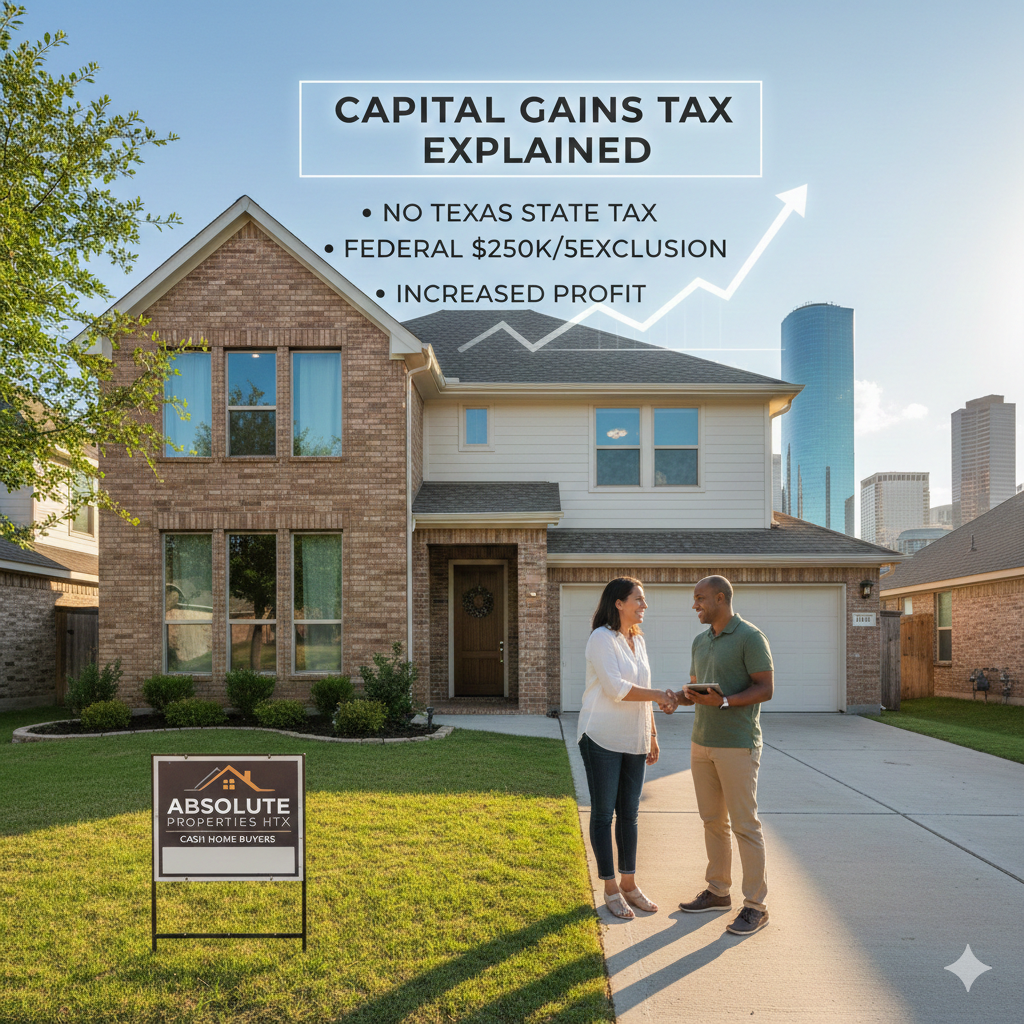
Understanding Houston, TX Capital Gains Tax: A Complete Guide for Homeowners
Navigating the financial landscape of a real estate transaction can be daunting, especially when it comes to the "T-word"—taxes. If you are preparing to sell a property in the Space City, you are likely asking: How much of my profit will I actually keep? Fortunately, for those looking to Sell my house fast Houston, the news is generally positive. Texas is widely celebrated as one of the most tax-friendly states in the nation, but that doesn't mean you are entirely off the hook. While the state itself won't take a cut of your home sale profits, the federal government certainly will if you don't plan correctly.
In this comprehensive guide, we will break down everything you need to know about Houston, TX capital gains tax. We will explore the difference between state and federal obligations, the "Primary Residence Exclusion" that saves homeowners thousands, and the specific strategies you can use to minimize your tax liability in 2026. Whether you are selling a long-term family home in the Heights or an investment property in Sugar Land, understanding these rules is the first step toward a successful and profitable closing.
The Lone Star Advantage: Does Texas Tax Capital Gains?
The most important thing for Houstonians to understand is the distinction between state and federal taxes. In many states, like California or New York, sellers are hit with a "double whammy": they pay federal capital gains tax to the IRS and an additional state-level income tax on those same profits.
Texas State Tax Policy
Texas is one of the few states that does not impose a state personal income tax. By extension, Texas does not have a state-level capital gains tax. This means that 100% of the capital gains tax you might owe will be paid to the federal government, with zero additional dollars going to the Texas Comptroller.
In late 2025, Texas voters further solidified this position by passing constitutional amendments (such as Proposition 2) that effectively prohibit the implementation of state-level taxes on realized or unrealized capital gains. This constitutional shield ensures that Houston remains a premier destination for real estate investors and homeowners who want to protect their equity.
Local Impact in Houston
While you won't pay capital gains to the state, remember that Houston has some of the highest property tax rates in the country. This makes it even more critical to understand your "basis" and potential gain, as the money you save on capital gains can often be used to offset the high carrying costs you've paid over the years through Harris County property taxes.
Federal Capital Gains Tax: How it Works in 2026
Even though Austin won't touch your profits, Washington D.C. will. The IRS views the profit from your home sale as "capital gain." To calculate this, you subtract your "adjusted basis" from your "realized sale price."
Short-Term vs. Long-Term Capital Gains
The duration of your ownership is the single most significant factor in determining your tax rate.
Short-Term Capital Gains: If you own the property for one year or less before selling, your profit is taxed as ordinary income. In 2026, federal income tax brackets can go as high as 37%. This is common for "fix-and-flip" investors.
Long-Term Capital Gains: If you own the property for more than one year, you qualify for preferential long-term capital gains rates. These rates are typically 0%, 15%, or 20%, depending on your total taxable income.
2026 Federal Tax Thresholds
For the 2026 tax year, the IRS has adjusted the income thresholds for long-term capital gains to account for inflation. Generally:
0% Rate: Applies to single filers with taxable income up to approximately $48,350 (or $96,700 for married couples filing jointly).
15% Rate: Applies to most middle-income earners.
20% Rate: Applies to high earners (typically those with taxable income exceeding $533,400 for individuals).
The Section 121 Exclusion: The Homeowner’s Shield
For the vast majority of people selling a home in Houston, the Section 121 Exclusion is the most valuable tool in the tax code. This rule allows you to exclude a massive portion of your profit from federal taxation entirely.
Eligibility Requirements
To qualify for this exclusion, you must pass the "Ownership and Use" tests:
Ownership: You must have owned the home for at least two of the five years leading up to the sale.
Use: You must have lived in the home as your primary residence for at least two of the five years leading up to the sale.
These two years do not have to be consecutive. You could live in the house for one year, rent it out for two, and then move back in for one year before selling.
How Much Can You Exclude?
If you meet the criteria, the IRS allows you to exclude:
$250,000 of profit if you are a single filer.
$500,000 of profit if you are married filing jointly.
For example, if a married couple in Houston bought a home in Memorial for $400,000 in 2015 and sells it in 2026 for $850,000, their profit is $450,000. Because this is less than the $500,000 exclusion limit, they would owe zero federal capital gains tax on the sale.
Exceptions to the Rule
There are "partial exclusions" available for those who have to sell their home before the two-year mark due to unforeseen circumstances, such as a change in employment (moving more than 50 miles for a job), health issues, or military service. Members of the uniformed services can actually suspend the five-year "look-back" period for up to 10 years while on extended duty.
Calculating Your "Adjusted Basis" to Reduce Tax
Many sellers make the mistake of thinking their "profit" is simply the sale price minus the purchase price. In reality, you can significantly reduce your taxable gain by calculating your Adjusted Basis.
What is Basis?
Your initial basis is what you paid for the home. However, you can add various costs to this number, which effectively lowers your "taxable profit."
Eligible Additions to Basis:
Capital Improvements: This includes major renovations like a new roof, a kitchen remodel, adding a swimming pool, or installing a new HVAC system. Routine repairs (like fixing a leaky faucet or painting a room) do not count.
Closing Costs from Purchase: When you originally bought the home, fees like title insurance, legal fees, and recording fees can be added to your basis.
Selling Expenses: When you sell, you can deduct the real estate agent's commission, staging costs, and advertising fees from your total sale price.
For detailed official guidance on what qualifies as a capital improvement, you can refer to the IRS Publication 523, which outlines the specific rules for selling your home.
Strategies for Real Estate Investors in Houston
If you are selling an investment property rather than a primary residence, the Section 121 Exclusion does not apply. In this case, you will likely owe capital gains tax on the full profit. However, there are two primary ways to mitigate this:
1. The 1031 Exchange
Named after Section 1031 of the Internal Revenue Code, this strategy allows an investor to "defer" paying capital gains taxes by reinvesting the proceeds from a sale into a "like-kind" property. In a hot market like Houston, this is a popular way to grow a portfolio without losing 15-20% of your equity to taxes every time you trade up. To learn more about the strict timelines involved, visit the Federation of Exchange Accommodators.
2. Depreciation Recapture
Investors must also be aware of depreciation recapture. During the years you owned the rental property, you likely claimed a depreciation deduction to lower your annual income tax. When you sell, the IRS "recaptures" that depreciation, taxing it at a flat rate of 25%. This is separate from the standard capital gains tax and must be factored into your net proceeds calculation.
FAQs: Houston, TX Capital Gains Tax
Do I have to report my home sale if I don't owe taxes?
Yes, in most cases. If you receive a Form 1099-S from the title company at closing, you must report the sale on your tax return, even if the entire gain is excluded under the Section 121 rules.
Can I use the primary residence exclusion more than once?
Yes. You can use the exclusion once every two years. This allows "serial renovators" in Houston to buy a fixer-upper, live in it for two years while renovating, sell it for a tax-free profit, and repeat the process.
Does Houston have a "Mansion Tax"?
Unlike cities like Los Angeles, Houston and the State of Texas do not currently have a "mansion tax" or a high-value transfer tax on luxury properties. You pay the same state-level rate (which is 0%) regardless of whether your home sells for $200,000 or $20,000,000.
What if I sell my home for a loss?
Unfortunately, while the IRS taxes your gains, they do not allow you to deduct a loss on the sale of a primary residence. Only losses on investment properties can be used to offset other capital gains (a process known as tax-loss harvesting).
Does the exclusion apply to second homes or vacation properties?
No. The $250,000/$500,000 exclusion is strictly for your principal residence. If you sell a vacation home in Galveston or a second home in Conroe, you will be subject to capital gains tax on the full profit unless you perform a 1031 exchange (if it was used as a rental).
Conclusion: Planning Your Houston Home Sale
Selling a home in Houston is a major financial milestone. While the lack of a Texas state capital gains tax provides a significant head start, the federal rules are complex and require careful record-keeping. By maximizing your adjusted basis through documented home improvements and timing your sale to meet the "two-out-of-five-year" rule, you can protect your hard-earned equity.
If you are feeling overwhelmed by the prospect of repairs, stagings, and tax implications, remember that there are options to simplify the process. Working with professional buyers can often provide a clearer picture of your net proceeds without the uncertainty of traditional market fluctuations. Regardless of how you choose to sell, always consult with a qualified tax professional or CPA to ensure you are fully compliant with the 2026 tax codes and taking advantage of every deduction available to you.
Would you like me to create a customized "Capital Gains Worksheet" to help you calculate your specific adjusted basis for your Houston property?

How Absolute Properties Helps Houston Sellers
Absolute Properties makes it easy for Houston homeowners to sell fast - even when facing challenges like financial difficulties, inherited properties, troublesome tenants, or repairs.
If you’re thinking, “I need to sell my house fast in Houston…” We buy houses in Houston in any situation or condition!
As-is, fast cash offers with clear terms
Many closing costs covered; no realtor commissions in most cases
You choose the closing date (as little as 7 days, case-dependent)
Coordination with experienced title company for a compliant sale process
Call or text: (713) 230-8059
Email address: info@absolutepropertieshtx.com
Share your street address and timeline for a free consultation and a straightforward number no pressure.
Helpful Houston Blog Articles
How To Sell Your House in Houston Without Sinking Any More Money Into It
6 Tips For First Time Home Sellers in Houston
Hiring an Agent Vs. A Direct Sale to Absolute Properties When Selling Your House in Houston
Who Pays Closing Costs in Texas
The True Costs of An FSBO Listing for Houston Investors
What To Do With Your Expired Listing in Houston
Also check out our Free Guides & Education & FAQ for more education on how to sell your house for cash quickly to a local home buyer.