Reviewed by Mark Lee
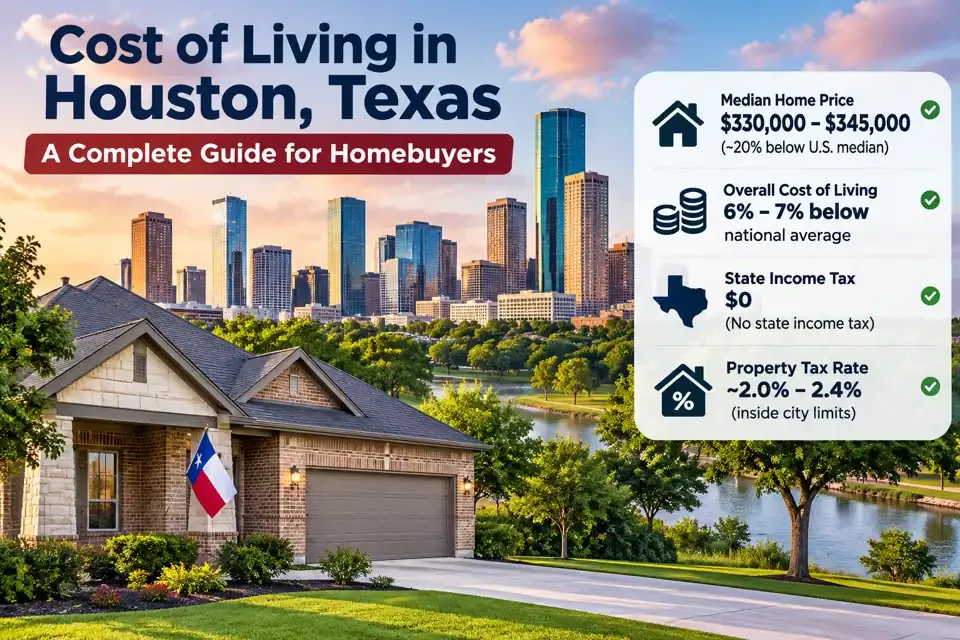
Relocating to the Bayou City or upgrading your footprint inside Harris, Fort Bend, or Montgomery County offers a rare combination in today's economy: big-city career opportunities paired with prices that let your paycheck breathe. While coastal metros force buyers into cramped townhomes or eye-watering mortgages, Greater Houston keeps the American dream of a detached single-family house with a real backyard squarely within reach. Overall, the cost of living in Houston sits roughly 6% to 7% below the national average and more than 24% below America’s largest metropolitan areas. Still, local expenses come with unique Lone Star quirks—from high property tax rates and summer air-conditioning surges to soaring windstorm insurance premiums—that can surprise unprepared buyers. If you are looking to offload an existing property before making your next move, working with Cash Home Buyers Houston gives you fast, certain liquidity without waiting on buyer financing contingencies.
Once you know what your purchasing power looks like, smart budgeting comes down to understanding where Houston saves you thousands—and where hidden homeowner costs quietly claw some of that cash back. Below, we break down every major expense category across Houston and the wider Texas market so you can buy with confidence.
Housing Market Breakdown: What Your Budget Buys in Houston
Housing is the single biggest reason families and corporate relocators flock to Southeast Texas. Unlike landlocked cities hemmed in by oceans or mountains, Houston expands outward along major highway corridors, allowing builders to deliver steady housing inventory across dozens of master-planned communities. According to market data from the Houston Association of Realtors, Greater Houston’s median single-family home price hovers around $330,000 to $345,000—roughly 20% below the U.S. median. Even compared to peer Texas metros like Austin (~$412,000) and Dallas–Fort Worth (~$390,000), Houston delivers noticeably more square footage per dollar.
Neighborhood Price Tiers: Inside the Loop vs. Outer Suburbs
Where you plant roots determines whether you pay a premium for walkability or score brand-new construction on a quarter-acre lot:
Inner Loop Luxury and Historic Districts ($500,000 – $1.2M+): Neighborhoods inside Interstate 610—such as The Heights, Montrose, West University, and River Oaks—command the highest price per square foot. You trade yard size and garage space for five-minute commutes to Downtown, the Texas Medical Center, and top dining corridors.
Established Close-In Suburbs ($350,000 – $550,000): Areas just outside the Loop like Oak Forest, Garden Oaks, Memorial, and Bellaire attract buyers seeking larger lots, mature oak canopies, and strong resale stability without a two-hour daily commute.
Master-Planned Growth Corridors ($280,000 – $450,000): Suburbs like Katy, Cypress, Sugar Land, Spring, Pearland, and Conroe form the backbone of Houston's family market. Builders frequently offer mortgage rate buydowns and closing cost incentives, letting buyers secure modern four-bedroom homes with resort-style community pools and trails.
Buying vs. Renting in Greater Houston
If you are still learning the layout of Harris County before committing to a deed, renting remains remarkably affordable compared to coastal cities. Average apartment rents across Houston land around $1,343 to $1,532 per month, while central one-bedroom units in Midtown or Downtown average near $1,725. Renting a three-bedroom single-family house in a suburban school district typically runs $2,100 to $2,400 monthly.
At a 6.14% to 6.67% 30-year fixed mortgage rate with 20% down, principal and interest on a $335,000 Houston home come out to roughly $1,630 to $1,725 a month. Once you factor in property taxes and insurance, owning costs slightly more upfront than renting an apartment, yet locks in your housing payment while building long-term equity in one of the nation's fastest-growing job engines.
Taxes and Hidden Homeowner Costs: The Texas Trade-Off
Ask any newcomer why they moved to Texas, and the answer is almost always the same: zero state income tax. Whether you earn $65,000 or $350,000, the State of Texas takes $0 from your paycheck, your annual bonus, or your retirement distributions. That immediate 5% to 10% take-home pay boost compared to states like California, New York, or Illinois funds a huge portion of a Houston mortgage. However, local governments still need revenue to fund schools, roads, and drainage—and they collect it through property and sales taxes.
Property Taxes, MUDs, and Homestead Exemptions
Texas ranks among the top ten states nationwide for effective property tax rates, and understanding how your bill is calculated prevents painful escrow surprises during year two of ownership. In Houston, your annual tax bill combines levies from multiple overlapping entities:
Base Taxing Jurisdictions: Your property funds the City of Houston (which held its municipal rate steady at $0.519190 per $100 valuation), Harris County (or Fort Bend/Montgomery County), Houston ISD or your suburban school district, the Harris County Flood Control District, and local community colleges. Inside city limits, combined rates typically fall between 2.0% and 2.4%.
Municipal Utility Districts (MUDs): When developers build new suburbs outside city limits, they create MUDs to finance water, sewer, and drainage infrastructure through municipal bonds. Newer master-planned communities in Katy, Cypress, or Waller County often carry combined tax rates between 2.8% and 3.4% until those infrastructure bonds pay down.
The Texas Residence Homestead Exemption: Never forget to file your homestead exemption through the Harris Central Appraisal District (or your local county appraisal office) after closing. Texas law removes $140,000 from your home's taxable value for school district taxes—and local entities like the City of Houston and Harris County grant additional percentage exemptions—often shaving $1,300 to $1,800 off your annual bill while capping yearly appraised value increases at 10%.
Homeowners Insurance and Flood Coverage
While your purchase price stays low, insurance represents the fastest-growing line item in a Houston homeowner's escrow account. Proximity to the Gulf of Mexico exposes Southeast Texas to tropical storms, hurricanes, hail, and severe convective winds. Standard homeowners insurance in Greater Houston regularly runs $3,500 to $5,200 per year, and most policies carry a separate 1% to 2% named-storm deductible.
Additionally, standard homeowners policies never cover rising water. Even if your prospective home sits outside a FEMA 100-year flood zone (Zone AE) and lands in moderate-to-low risk Zone X, smart Houston buyers carry a preferred-risk flood policy through the National Flood Insurance Program (NFIP) or a private carrier, typically adding $650 to $1,100 annually for complete peace of mind.
Combined Sales Tax
Texas enforces a 6.25% statewide sales tax, and Houston adds the maximum 2.0% local transit and municipal allocation for a flat 8.25% combined sales tax. Groceries and prescription medications remain exempt from sales tax, helping keep everyday household essentials affordable.
Everyday Living Expenses: Utilities, Groceries, and Healthcare
Once your mortgage, taxes, and insurance are squared away, Houston shines in day-to-day affordability. Core monthly bills consistently track below U.S. benchmarks, leaving extra room in your budget for dining, travel, or savings.
Utilities: Navigating Deregulated Electricity and Summer Heat
Texas operates a deregulated retail electricity market across the ERCOT grid, meaning Houston homeowners choose their own electricity provider rather than buying power from a single monopoly utility. While CenterPoint Energy maintains the physical power lines, you can shop competitive fixed-rate plans through dozens of retail providers.
Average Monthly Energy Costs: Typical Houston residential electricity and natural gas bills average right around $195 to $215 per month across the full year—roughly 6% to 8% below the national average.
The Seasonal Swing: Expect mild winter utility bills from November through March, followed by peak cooling bills between June and September when triple-digit heat indices keep central A/C running nonstop. Buying a home with double-pane low-E windows, radiant barrier attic decking, and a high-SEER heat pump can easily save $120+ every summer month.
Water, Trash, and Internet: Municipal water, sewer, and trash collection add roughly $85 to $130 monthly depending on lawn irrigation, while high-speed fiber internet averages $65 to $75 per month.
Groceries and Dining Out
Texas benefits from massive agricultural production, Gulf Coast ports, and intense grocery competition led by H-E-B, Kroger, Aldi, and Walmart. Grocery prices in Houston sit roughly 1.5% to 2.3% below the national average. A single adult typically spends $350 to $400 per month on groceries, while a family of four budgets $950 to $1,350 depending on dining habits.
Houston is also widely recognized as one of America’s most diverse food cities—and eating out won't wreck your budget. A casual lunch at a neighborhood Tex-Mex or Vietnamese spot runs $15 to $20 per person, and a three-course dinner for two at a mid-range restaurant averages around $75 before drinks and tip.
Healthcare Costs
Anchored by the Texas Medical Center—the largest medical complex in the world—Houston offers unmatched access to specialists, research hospitals, and urgent care clinics. Routine medical care, dental checkups ($140–$145), and vision exams trend roughly 3% to 4% cheaper than the national average.
Transportation and Commuting: Budgeting for Life on Texas Highways
Spread across more than 600 square miles of city limits and a ten-county metro area, Houston is undeniably a driving city. Transportation costs overall sit about 3% to 4% lower than the U.S. average, primarily because proximity to Gulf Coast refineries keeps fuel prices among the lowest in the country.
Fuel, Tolls, and Auto Insurance
Gasoline Prices: Regular unleaded in Houston routinely hovers around $2.60 to $2.90 per gallon—often $1.00 to $1.75 less per gallon than West Coast or Northeast states.
Toll Roads: Commuting efficiently across Greater Houston often involves the Sam Houston Tollway (Beltway 8), the Westpark Tollway, the Hardy Toll Road, or Grand Parkway (SH 99). Daily commuters using an EZ TAG or TxTag should budget $60 to $140 per month in toll charges depending on their route.
Auto Insurance and Registration: Texas keeps annual vehicle registration simple and inexpensive at roughly $75 to $85 per year. Auto insurance, however, runs higher than the national average due to heavy highway traffic, uninsured drivers, and hail claims—expect to pay $160 to $230 per month for full coverage on a single vehicle.
Public Transit: While most suburban residents drive, METRO operates light rail lines connecting Downtown, Midtown, the Museum District, and the Medical Center alongside commuter Park & Ride buses, with single rides costing $1.25 and monthly local passes around $75.
Monthly Cost of Living Snapshot: Houston vs. Texas & U.S. Averages
To put these numbers into practical perspective, compare typical monthly household expenses across different living arrangements in Greater Houston against broader Texas and national benchmarks:
| Expense Category | Single Adult (Renter) | Couple (Homeowners) | Family of Four (Homeowners) | Houston vs. U.S. Avg |
|---|---|---|---|---|
| Housing (Rent or P&I + Escrow) | ~$1,450 / mo | ~$2,350 / mo | ~$2,750 / mo | ~20%–22% Lower |
| Utilities & Internet | ~$220 / mo | ~$340 / mo | ~$420 / mo | ~6%–8% Lower |
| Groceries & Household Supplies | ~$380 / mo | ~$720 / mo | ~$1,150 / mo | ~2% Lower |
| Transportation (Gas, Ins., Tolls) | ~$420 / mo | ~$780 / mo | ~$950 / mo | ~3%–4% Lower |
| Healthcare & Out-of-Pocket | ~$150 / mo | ~$310 / mo | ~$430 / mo | ~3%–4% Lower |
| Dining, Entertainment & Misc. | ~$450 / mo | ~$850 / mo | ~$1,100 / mo | ~1%–2% Higher |
| Estimated Total Monthly Budget | ~$3,070 / mo | ~$5,350 / mo | ~$6,800 / mo | ~6.5% Lower Overall |
Note: Homeowner figures assume a 20% down payment on a median-priced Greater Houston property including property taxes and windstorm insurance.
Smart Financial Moves Before You Buy a Home in Houston
Buying real estate in Southeast Texas rewards local diligence. Before you submit an offer on a home in Houston or its surrounding suburbs, take four essential steps to protect your long-term budget:
Verify the Total Tax Rate by Parcel, Not Just City Average: Two houses two miles apart in Katy or Spring can differ by 0.9% in annual property taxes depending on whether one sits inside an active Municipal Utility District (MUD). Always check the exact parcel tax rate—not the seller's discounted senior-freeze bill—before calculating your monthly payment.
Pull Elevation Certificates and Historical Flood Maps: Ask your agent to check Harris County Flood Control District inundation maps alongside FEMA flood zones. Inspect drainage grading around the slab foundation, confirm gutter downspouts discharge away from the perimeter, and get an insurance quote during your option period rather than waiting until closing week.
Shop Your Electricity Plan Before Move-In Day: Never let your power default to a variable month-to-month holdover rate. Lock in a fixed-rate 12-month or 24-month electricity contract tailored to your home’s square footage so summer cooling spikes stay predictable.
Factor HOA Amenities Into Your Lifestyle Math: Many Houston master-planned communities charge $600 to $1,400 annually in HOA dues, yet those fees frequently include neighborhood pools, splash pads, tennis courts, fitness centers, and patrol security—potentially letting you cancel a $120/month family gym membership.
Frequently Asked Questions About the Cost of Living in Houston, Texas
What salary do you need to live comfortably in Houston?
A single adult renting a one-bedroom apartment can live comfortably in Houston on roughly $52,000 to $60,000 per year, keeping housing costs near the recommended 30% income threshold. For a family buying a median-priced single-family home ($330,000–$345,000) while saving for retirement and covering childcare or vehicles, a combined household income of $95,000 to $115,000 provides a very comfortable cushion.
Is Houston cheaper than Austin and Dallas?
Yes. Houston consistently ranks as the most affordable major metropolitan area in Texas. Median home prices in Houston run roughly $50,000 to $80,000 lower than in Dallas–Fort Worth and Austin, while everyday groceries, utilities, and childcare expenses also track slightly below North and Central Texas averages.
Why are property taxes so high in Texas if there is no state income tax?
Because Texas collects zero personal state income tax, local counties, cities, and independent school districts rely heavily on property taxes and sales taxes to fund public schools, emergency services, and roads. While effective rates sit around 2.0% to 2.5%, lower home purchase prices and generous homestead exemptions keep total housing costs far below coastal states.
How much should I budget for homeowners and flood insurance in Houston?
Plan on $3,500 to $5,200 annually for a standard homeowners insurance policy with windstorm coverage, plus $650 to $1,100 per year for a flood insurance policy if you live in a low-to-moderate flood risk zone. Homes with newer roofs (under five years old) and impact-resistant shingles often qualify for substantial insurer discounts.
Are utilities expensive in Houston during the summer?
Despite scorching July and August temperatures, Houston’s annual utility costs remain roughly 6% to 8% below the national average thanks to Texas’s competitive deregulated electricity market. While your electric bill may climb to $250–$350 in peak summer months for a detached house, mild winters keep bills under $120 for half the year.

How Absolute Properties Helps Houston Sellers
Absolute Properties makes it easy for Houston homeowners to sell fast - even when facing challenges like financial difficulties, inherited properties, troublesome tenants, or repairs.
If you’re thinking, “I need to sell my house fast in Houston…” We buy houses in Houston in any situation or condition!
As-is, fast cash offers with clear terms
Many closing costs covered; no realtor commissions in most cases
You choose the closing date (as little as 7 days, case-dependent)
Coordination with experienced title company for a compliant sale process
Call or text: (713) 230-8059
Email address: info@absolutepropertieshtx.com
Share your street address and timeline for a free consultation and a straightforward number no pressure.
Know someone else who needs to sell? We Also Pay a $1000 Referral Fee!
Helpful Houston Blog Articles
How To Sell Your House in Houston Without Sinking Any More Money Into It
6 Tips For First Time Home Sellers in Houston
Hiring an Agent Vs. A Direct Sale to Absolute Properties When Selling Your House in Houston
Who Pays Closing Costs in Texas
The True Costs of An FSBO Listing for Houston Investors
What To Do With Your Expired Listing in Houston
Also check out our Free Guides & Education & FAQ for more education on how to sell your house for cash quickly to a local home buyer.