Reviewed by Mark Lee
You open Zillow at 11:00 PM on a Tuesday. You pull up two houses in Greater Houston, both listed at $425,000. One sits on a quiet cul-de-sac in Katy with 2,600 square feet, while the other is a 1,700-square-foot bungalow tucked into The Heights. On paper, their price tags match, yet their value per foot is wildly different.
If you only look at the sticker price, you fly blind in a market as sprawling and hyper-local as Southeast Texas. Whether you are hunting for a starter home near the Energy Corridor or preparing a distressed property for the market—maybe even weighing options with Cash Home Buyers Houston before listing—understanding how to calculate and interpret price per square foot separates smart buyers from folks who overpay by fifty grand.
Houston real estate refuses to play by uniform rules. A lack of traditional zoning means a million-dollar custom build can sit directly across the street from an unrenovated 1960s ranch. Calculating price per square foot gives you a baseline ruler, provided you know how to measure the right things and when to throw the ruler out the window.
The Basic Formula and What Actually Counts in Texas
Calculating the raw number takes five seconds on your phone calculator. You take the property's purchase price (or current listing price) and divide it by the total livable square footage.
Price Per Square Foot = Purchase Price ÷ Total Livable Square Footage
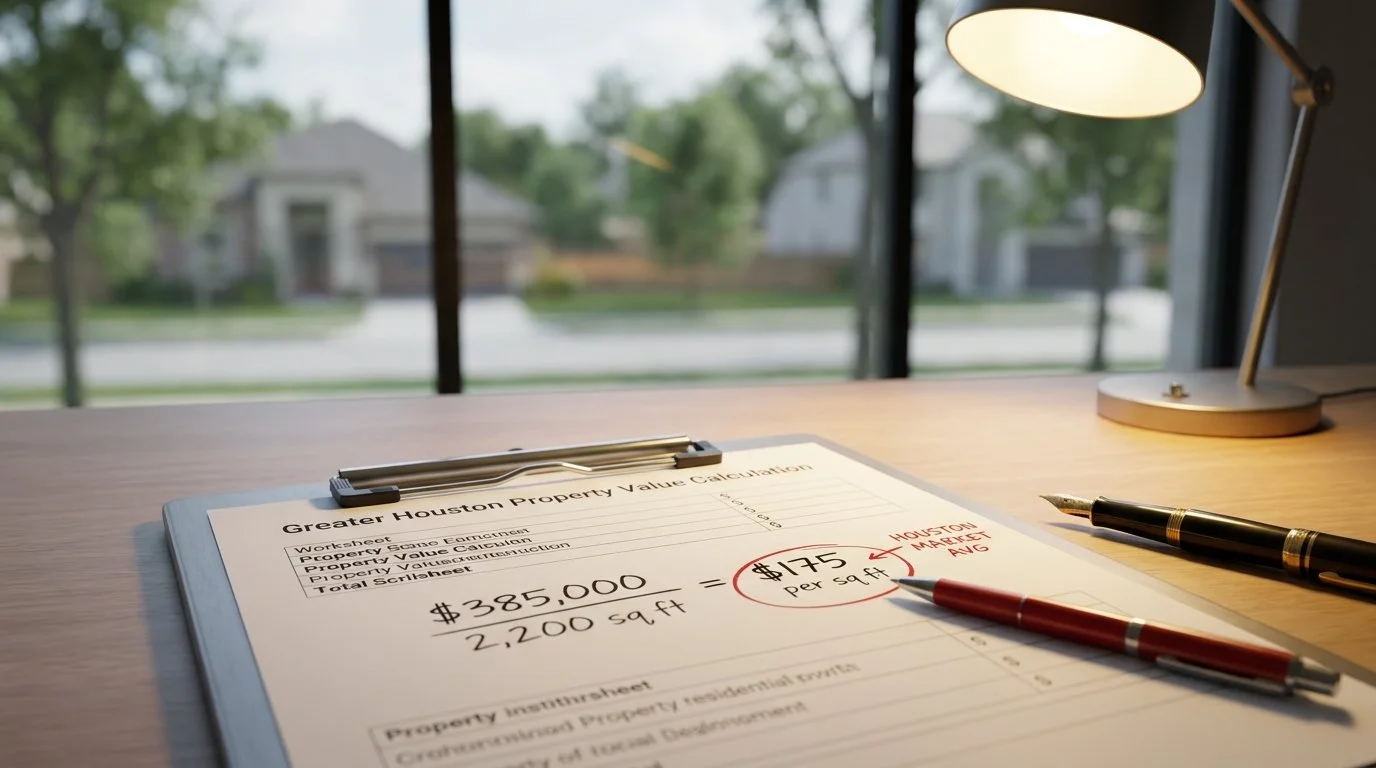
Say you are eyeing a 2,200-square-foot home in Cypress listed at $385,000. Divide $385,000 by 2,200, and you land at $175 per square foot. Simple enough, right? The trap lies in that second number: total livable square footage.
In Texas, real estate agents, county appraisal districts, and homeowners frequently disagree on what counts toward that denominator. When you run your own math, stick strictly to Gross Living Area (GLA). Appraisers define GLA as finished, heated, and cooled space above ground level that connects directly to the main living quarters.
What Never Counts Toward Your Square Footage
If a listing agent inflates the square footage by tossing non-livable areas into the pot, your price-per-square-foot calculation gets artificially low, making a bad deal look like a bargain. Strip these spaces out before you divide:
Attached and Detached Garages: Even if the previous owner laid down epoxy flooring, hung drywall, and threw a window AC unit in the two-car garage, it remains garage space unless it underwent a permitted, permanent conversion into the main HVAC system.
Covered Patios and Sunrooms: Houstonians love outdoor kitchens and screened-in porches, especially in master-planned communities like Bridgeland or Sienna. Unless a sunroom is fully insulated, permitted, and tied into the central air conditioning, exclude it from your GLA math.
Unfinished Attics and Bonus Rooms: Texas soil and high water tables mean almost nobody has a basement here, so builders build up. Unfinished attic storage over the garage does not count, even if it has subflooring.
Detached Guest Houses or Sheds: A backyard casita or "she-shed" adds market value, certainly, but appraisers calculate detached structures separately from the primary residence's square footage.
Always cross-reference the MLS listing number against the local county appraisal district records—whether that is HCAD (Harris County Appraisal District), FBCAD (Fort Bend), or MCAD (Montgomery County). County records aren't infallible, as unpermitted additions often slip past assessors, but massive discrepancies between the MLS and tax rolls serve as an immediate yellow flag. For official guidelines on how appraisers measure residential properties, check out the Fannie Mae Selling Guide on Gross Living Area to see the exact standards lenders enforce.
Why Houston Neighborhoods Break the Square-Foot Rule
If you take a statewide Texas average—say, $185 per square foot—and try to apply it across the Greater Houston metro area, you will either lose every bidding war or wildly overpay. Houston isn't one unified real estate market; it is dozens of distinct micro-markets stitched together by loops and tollways.
Inside the Loop vs. Outer Suburbs
Location drives the numerator far more aggressively than construction costs do. Inside Loop 610, you are paying for dirt, commute times to the Texas Medical Center or Downtown, and walkability. A renovated 1,800-square-foot Craftsman in Woodland Heights might command $425 per square foot, whereas a brand-new 2,800-square-foot two-story home in Spring or Richmond might trade at $155 per square foot.
When building your "super-duper specific" home search, shrink your comparison radius dramatically. Never compare a house in Memorial Villages to one in Spring Branch just because they share a similar zip code border. In Houston, crossing a single major thoroughfare like I-10, Westheimer, or Buffalo Bayou can swing property values by $100 per square foot overnight.
Master-Planned Communities and Mud Taxes
In suburban strongholds like The Woodlands, Sugar Land, Friendswood, and Pearland, subdivision boundaries dictate pricing. Master-planned communities maintain strict architectural controls and uniform builder floor plans, making price-per-square-foot calculations remarkably reliable within the same neighborhood section.
However, pay close attention to Municipal Utility District (MUD) tax rates and HOA dues. Two subdivisions three miles apart in Katy might sell identical 2,500-square-foot floor plans at $190 per square foot. If Subdivision A carries a 3.2% total property tax rate due to a newer MUD bond and Subdivision B sits at 2.1%, your monthly mortgage payment changes drastically even though the price per square foot looks identical.
Step-by-Step: Running Hyper-Specific Comps Like an Appraiser
To figure out if a specific house is priced fairly, you cannot just look at active listings. Sellers can ask whatever they want; closed sales tell you what buyers actually paid. Follow this exact workflow to calculate a trustworthy neighborhood benchmark.
Draw a Tight Geographic Box: Filter your search to homes within a half-mile to one-mile radius of your target property. Stay inside the same subdivision and the exact same zoned elementary and high schools.
Filter by Time: Pull properties that closed within the last 90 to 180 days. Houston's market moves seasonally, with spring and early summer inventory behaving differently than late autumn sales.
Match the Era and Style: Compare apples to apples. A 1955 pier-and-beam ranch in Bellaire carries completely different structural dynamics than a 2022 three-story townhome in Midtown. Keep your comps within 10 to 15 years of the target home's build date whenever possible.
Isolate Similar Square Footage: Economies of scale apply to residential housing. Smaller homes almost always sell for a higher price per square foot than massive ones because every house needs a kitchen, an HVAC system, a roof, and a water heater—the most expensive components per square foot. Compare a 2,000-square-foot home against comps between 1,750 and 2,250 square feet.
Calculate the Sold Average: Take the actual sold prices (not the original list prices) of your top three to five closest matches. Divide each by its livable square footage, then average those numbers together.
Once you have that baseline figure—say, $212 per square foot—multiply it by the square footage of the house you want to buy. That gives you your starting anchor before you adjust for condition.
Six Houston-Specific Factors That Skew the Math
Raw math only gets you to the fifty-yard line. Before you submit an offer or set a listing price, you have to adjust your price-per-square-foot calculation for the physical realities of Gulf Coast living.
1. Foundation Health and Expansive Clay Soil
Houston sits on heavy, expansive Beaumont clay that swells when soaked by torrential rain and shrinks during August droughts. That constant movement wreaks havoc on concrete slabs. A home with documented, warrantied foundation repairs—or one that currently needs 18 interior and exterior piers—cannot command the same price per square foot as a neighboring house with a level slab. If a house needs $15,000 in foundation work and plumbing tunnel repairs, deduct that straight off the top of your valuation.
2. Floodplain Status and Elevation
In Greater Houston, elevation is everything. Two identical houses on the same street can have vastly different values if one sits in the 100-year floodplain (Zone AE) and the other sits in Zone X (minimal flood hazard). Homes with a history of flooding—especially from Hurricane Harvey or the Tax Day floods—typically trade at a noticeable discount per square foot unless they have been structurally elevated above base flood elevation. You can verify any property's exact flood zone boundaries directly through the FEMA Flood Map Service Center.
3. Lot Size and Usable Yard Space
Price per square foot only measures the building, completely ignoring the dirt underneath it. In inner-loop neighborhoods like Oak Forest or Garden Oaks, a standard 6,600-square-foot lot sells for substantially less per building foot than an oversized 11,000-square-foot lot down the block. Similarly, a home backing up to a greenbelt, lake, or cul-de-sac warrants a higher price per square foot than a house backing directly onto a noisy four-lane feeder road.
4. One-Story vs. Two-Story Floor Plans
Across Texas suburbs, single-story homes consistently sell for a higher price per square foot than two-story homes of the exact same size. Why? Construction costs. A 2,400-square-foot one-story house requires twice as much concrete foundation slab and twice as much roof framing as a 2,400-square-foot two-story house. Plus, downsizing retirees and families with young kids compete fiercely for single-level living, driving up demand.
5. Major Mechanical Ages (Roof, HVAC, and Piping)
In our humid subtropical climate, air conditioners work overtime eight months out of the year, and summer hailstorms chew through asphalt shingles. If a comp sold at $200 per square foot with a brand-new 16-SEER HVAC system, a two-year-old roof, and updated PEX plumbing, you shouldn't pay $200 per square foot for a house sporting a 17-year-old AC unit, galvanized steel pipes, and curling shingles.
6. Cosmetic Finishes and Layout Efficiency
A 2,200-square-foot house with a choppy 1970s layout, dark paneling, and a cramped galley kitchen lives much smaller than a bright, open-concept 2,200-square-foot home with quartz countertops, white oak floors, and ten-foot ceilings. Buyers pay a steep premium per square foot for turnkey, move-in-ready aesthetics because renovation labor and material costs remain elevated.
How to Use Price Per Square Foot During Negotiations
Smart buyers and sellers treat price per square foot as a diagnostic tool rather than a rigid law. When you walk through a showing, look at the listing's price per square foot and ask yourself: Does the physical house justify this number compared to recent neighborhood sales?
If a seller in Clear Lake lists their home at $195 per square foot when the neighborhood average sits at $170, look for the justification. Did they add a heated pool? Did they gut-remodel the primary bath and kitchen down to the studs? If yes, that $25-per-foot premium makes complete sense. If the house still rocks original builder-grade carpet and laminate counters from 2004, the seller is overpricing based on emotion, and your comp data gives you concrete leverage to negotiate the price down.
On the flip side, when you spot a home priced $30 per square foot below the neighborhood average, don't celebrate too quickly. Put on your detective hat. Check the seller's disclosure notice for past water intrusion, inspect the electrical panel for outdated Federal Pacific or Zinsco breakers, and walk the perimeter looking for stair-step cracks in the brick veneer. Sometimes you have uncovered an overlooked gem priced aggressively for a quick sale; other times, you are looking at a heavy fixer-upper hiding $60,000 in deferred maintenance.
Frequently Asked Questions
Does a swimming pool add to a home's livable square footage in Texas?
No. Swimming pools, spas, outdoor kitchens, and covered pergolas never count toward a home's livable square footage. While an in-ground pool definitely adds overall market value—especially in hot Houston suburbs like Kingwood, Katy, and League City—appraisers treat it as an exterior amenity line-item rather than lumping it into the price-per-square-foot calculation.
Why does Zillow's price per square foot sometimes differ from the county tax appraisal?
Online real estate portals pull data from multiple feeds, including MLS listings, historical tax assessments, and user-submitted updates. County appraisal districts like HCAD or FBCAD measure exterior wall dimensions during tax assessments, whereas builders or sellers sometimes list slightly different interior figures. Always verify square footage using the official appraisal district sketch or an independent appraiser's measurement before finalizing an offer.
Is price per square foot accurate for new construction homes in Houston?
It is useful for comparing base floor plans from different builders within the same master-planned community, such as comparing Perry Homes against Highland Homes in Bridgeland or Elyson. However, new construction base prices rarely reflect what you actually pay at closing. Structural upgrades, lot premiums, elevation choices, and design center finishes easily add 15% to 25% to the final contract price, pushing your true price per square foot much higher than the model home brochure advertises.
Should I use price per square foot when buying land or tear-down lots in Houston?
Never. When buying tear-down properties in transitioning neighborhoods like Independence Heights, East Downtown (EaDo), or parts of Spring Branch, the existing structure holds zero or even negative value because you have to pay to demolish and haul it away. In those scenarios, calculate price per square foot of the lot instead of the building.
How much should I deduct per square foot for a house that needs a full renovation?
Rather than guessing a flat per-foot discount, calculate the actual rehab budget and subtract it from the After Repair Value (ARV). If renovated homes in a Sugar Land neighborhood sell for $220 per square foot, a 2,000-square-foot home has an ARV of $440,000. If that property needs $75,000 in foundation, roof, and interior updates—plus holding costs and a reasonable margin—your target purchase price drops closer to $315,000 to $330,000, or roughly $160 per square foot.

How Absolute Properties Helps Houston Sellers
Absolute Properties makes it easy for Houston homeowners to sell fast - even when facing challenges like financial difficulties, inherited properties, troublesome tenants, or repairs.
If you’re thinking, “I need to sell my house fast in Houston…” We buy houses in Houston in any situation or condition!
As-is, fast cash offers with clear terms
Many closing costs covered; no realtor commissions in most cases
You choose the closing date (as little as 7 days, case-dependent)
Coordination with experienced title company for a compliant sale process
Call or text: (713) 230-8059
Email address: info@absolutepropertieshtx.com
Share your street address and timeline for a free consultation and a straightforward number no pressure.
Know someone else who needs to sell? We Also Pay a $1000 Referral Fee!
Helpful Houston Blog Articles
How To Sell Your House in Houston Without Sinking Any More Money Into It
6 Tips For First Time Home Sellers in Houston
Hiring an Agent Vs. A Direct Sale to Absolute Properties When Selling Your House in Houston
Who Pays Closing Costs in Texas
The True Costs of An FSBO Listing for Houston Investors
What To Do With Your Expired Listing in Houston
Also check out our Free Guides & Education & FAQ for more education on how to sell your house for cash quickly to a local home buyer.