5 Ways to Find Houses Sold Near Me in Houston, TX
Reviewed by Mark Lee
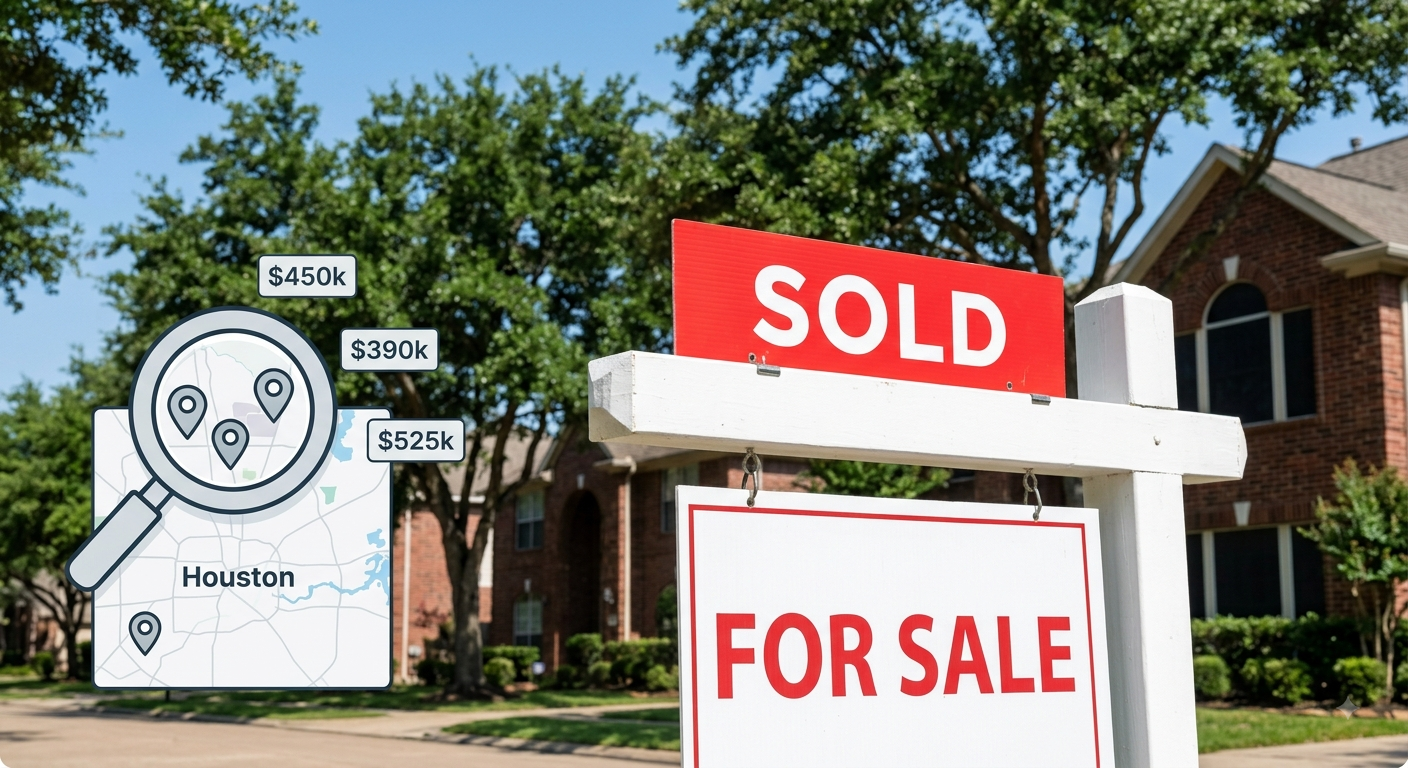
Have you ever driven through your Houston neighborhood, spotted a shiny new "Sold" rider slapped on top of a neighbor's yard sign, and immediately wondered, "What did they actually get for that place?" If you have, you’re definitely not alone. We all want to know. Real estate is the ultimate neighborhood spectator sport, especially here in Texas. But beyond basic curiosity, knowing the exact final sales prices of homes in your immediate area is incredibly powerful financial data.
Whether you're contesting your soaring property taxes with the county, preparing to list your current home on the traditional market, or simply exploring options with Cash Home Buyers Houston to offload an inherited property quickly, you absolutely need to know your local market's baseline. You simply can’t make an informed financial decision regarding your largest asset without knowing the real, tangible numbers.
But here’s the catch: Texas is a strict non-disclosure state. That means home sales prices are not public record. When a house closes in Houston, the exact dollar amount doesn’t automatically get published in the local newspaper or beamed directly to public county deed records like it does in other states. This little legislative quirk makes finding accurate "sold" data a bit of a treasure hunt for the average homeowner.
Fortunately, you don't need a real estate license or a background in private investigation to crack the code. As a senior real estate strategist who has analyzed this market from Galveston to The Woodlands, I'm going to pull back the curtain. Here are the five most effective, foolproof ways to find out exactly how much houses are selling for right in your own backyard.
1. Tap into the Houston Association of Realtors (HAR.com)
If you live in the Greater Houston area, you have a massive advantage over buyers and sellers in almost every other city in the country, and its name is HAR.com. The Houston Association of Realtors operates one of the most robust, consumer-facing real estate portals in the entire United States. Unlike generic national websites that simply aggregate data using automated algorithms, HAR is directly tied to the local Multiple Listing Service (MLS). It is the true source code of Houston real estate.
Why HAR is the Gold Standard in Texas
In a non-disclosure state, national portals often struggle to get accurate final sales data. They have to guess or rely on patchy public records. HAR doesn't guess. Because it is run by the actual board of Realtors who are plugging in the final closing documents, the data on HAR is as close to gospel as you can get without holding the signed closing papers in your hand. When a real estate agent closes a deal in Katy, Sugar Land, or Pearland, they are required by local board rules to update the listing status and input the final sales price into the MLS system promptly.
How to Search Sold Properties on HAR
Getting this information is surprisingly simple if you know exactly where to click. First, head over to HAR.com or download their highly-rated mobile app. Instead of just typing in a city or zip code right away and looking at active listings, navigate to the "More Filters" section of the search bar.
Look for the "Property Status" dropdown menu. By default, it will be set to "Active" or "For Sale." You want to uncheck those and exclusively check the box labeled "Sold." Next, you need to set your timeline. Real estate is intensely time-sensitive. A house that sold two years ago tells you absolutely nothing about today's market. Set your search parameters to show homes sold within the last three to six months. Anything older than six months is generally considered stale data by appraisers and lenders.
Finally, narrow down the geographic area. Don't just search "Houston" because the market inside the 610 Loop behaves wildly differently than the market out in Cypress or Tomball. Draw a polygon on the map tool directly around your specific subdivision to see the exact houses that have changed hands recently, complete with full photo galleries, days on market, and their final recorded sales prices.
2. Scour National Real Estate Portals (Zillow, Redfin, Realtor.com)
While HAR is the undisputed king of Houston real estate data, national mega-portals like Zillow, Redfin, and Realtor.com still deserve a spot in your investigative toolkit. These platforms spend billions of dollars on user experience, meaning their map interfaces, satellite views, and mobile apps are incredibly intuitive for the average homeowner trying to do a little Sunday morning market research from their couch.
Navigating Zillow’s “Recently Sold” Filter
If you want to use Zillow to find sold homes, the process is straightforward, but you have to be intentional about your filters. Open the Zillow map and zoom in tightly on your specific Houston neighborhood. Click on the "For Sale" filter at the top of the screen and switch it to the yellow "Sold" dot. Instantly, the map will populate with a sea of yellow dots representing past transactions.
You can click on any of these dots to pull up the property's historical listing. You’ll be able to see the original list price, the price cuts (if any were made during the listing period), and the date the property finally closed. This is excellent for identifying macro trends in your subdivision. Are homes in your neighborhood selling in two weeks, or are they sitting for two months? Are there a lot of price reductions happening before they finally go under contract?
The Texas Non-Disclosure Caveat
Now, here is the massive warning label you need to attach to these national sites when using them in Texas. Because of our strict non-disclosure laws, Zillow and Redfin cannot simply scrape county tax records to find the exact sales price like they do in Florida or New York. They rely entirely on broker syndication—meaning the broker has to choose to push that sold data to them.
Often, the actual sold price will be completely hidden, and the site will only display a price range or the last known asking price before the home went under contract. On top of that, you must aggressively ignore the "Zestimate" or Redfin Estimate. These algorithmic pricing tools do not know if your neighbor completely gutted and renovated their kitchen, or if they have a severe foundation issue. They are mathematical guesses based on aggregate regional data, and in a non-disclosure state, their margin of error is notoriously high. Use these national sites for the raw historical listing data and photos, not for their robotic price opinions.
3. Leverage the Harris Central Appraisal District (HCAD)
If you really want to get into the weeds of property data, you need to visit the local county appraisal district website. For the bulk of Houston, that means visiting the Harris Central Appraisal District (HCAD). If you live in the surrounding suburbs, you might be looking at Fort Bend CAD, Montgomery CAD, or Brazoria CAD depending on your zip code. These county websites are absolute treasure troves of hyper-local property information.
Understanding Assessed Value vs. Market Value
Before you start clicking around HCAD and panicking about the numbers you see, we need to establish a very clear distinction: the county's assessed value is rarely the exact same as the actual open-market sales price. The appraisal district's sole job is to assess property values for the purpose of levying local property taxes. They conduct mass appraisals using general formulas and aerial photography, not in-person tours.
However, while the assessed value isn't a perfect reflection of a recent sale price, it is a phenomenal baseline. When a home is sold on the open market, the appraisal district usually takes notice, and you will frequently see the home's assessed value jump the following calendar year to reflect a number much closer to the actual transaction amount.
How to Navigate HCAD (and other TX CADs)
The real power of HCAD isn't just in the valuation number; it’s in the physical structural data. Let's say you see a house down the street sell and you want to know how it compares to yours. You can go to HCAD, type in that address, and pull up the full public record.
You will see the exact permitted square footage, the year it was built, the total lot size, the exterior wall type (brick veneer vs. hardi plank), and whether or not it has a private pool on record. You can even see the footprints of the structures on the lot. By looking at the property tax records of recently sold homes near you, you can compare their physical specs apples-to-apples with your own home. If the house that just sold for top dollar is 500 square feet larger than yours and features a custom pool, you immediately know that your home will likely command a slightly lower price point, regardless of what the rumor mill in the neighborhood Facebook group insists.
4. Lean on a Local Houston Real Estate Agent
Technology is fantastic, and consumer portals have democratized a ton of information over the last decade. But if you want absolute, laser-precise accuracy regarding what houses are selling for in your specific pocket of Houston, absolutely nothing beats the boots-on-the-ground expertise of a licensed real estate professional. Algorithms don't walk through houses; local agents do.
The Power of the MLS Comparative Market Analysis (CMA)
Real estate agents have direct, unfiltered access to the backend of the Multiple Listing Service. They see the raw data that the public doesn't. When you ask a local Realtor to help you understand your home's current value, they will generate a Comparative Market Analysis, commonly known in the industry as a CMA.
A CMA is a comprehensive, granular report that pulls data on active listings, pending sales, and recently sold properties (the "comps") that closely match your home's specific criteria. But an agent brings context that a spreadsheet simply cannot. An agent can look at a comp and say, "Yes, that house sold for $450,000, but I showed that house to a buyer, and I know it backed up directly to a noisy commercial shopping center, which dragged the price down." They know the nuances of a Houston floor plan, the premium placed on being zoned to specific highly-rated independent school districts (ISDs), and the massive negative impact of being located in a 100-year flood plain.
Off-Market Sales and Pocket Listings
Another massive benefit of connecting with an agent is tapping into their private network. In a highly competitive market, a surprising number of homes in Houston are sold "off-market" or as "pocket listings." These are properties that are sold directly from a seller to a buyer without ever hitting the public MLS or sites like Zillow.
Because these transactions happen quietly, they won't show up in your standard online search. A well-connected local agent talks to other agents, title officers, and investors daily. They know when a house three streets over sold quietly for cash before a sign ever went in the yard. If you truly want the complete picture of your neighborhood's financial landscape, a brief consultation with a local market expert is arguably your most powerful investigative tool.
5. Drive the Neighborhoods and Talk to Locals
Let’s take it completely offline for a moment. Sometimes, the most valuable real estate data is gathered the old-fashioned way: boot leather, gasoline, and good old-fashioned neighborly conversation. Houston is a sprawling, wildly diverse metropolis, and every single subdivision—from the historic Heights to the master-planned communities of Katy—has its own micro-economy.
The Boot-Leather Approach in Houston Suburbs
Make it a habit to actually drive or walk your neighborhood regularly. Pay close attention to the yard signs. When you see a "Coming Soon" sign transition to an "Active" sign, and then finally a "Pending" or "Sold" sign, take note of the timeline in your head. How many days did it take? Did the sign sit there fading in the brutal Texas sun for four months, or did it sell over the opening weekend?
If you happen to see the homeowner outside, or if you spot moving trucks loading up, don't be afraid to strike up a polite conversation. Texans are generally friendly folks. You don't have to awkwardly ask, "Exactly how many dollars did you get for this place?" Instead, ask open-ended questions. "Hey, congratulations on the sale! I live a few streets over. How was the process? Did you guys get a lot of traffic?" Often, people are so relieved that the stressful process is over that they will happily overshare the details of their transaction, including whether they got multiple offers over asking price or if they had to offer massive seller concessions just to close the deal.
Networking with Houston Real Estate Investors
Another incredibly effective offline tactic is networking with local real estate investors. According to data from the Texas Real Estate Research Center, investor activity in major metros like Houston makes up a significant chunk of property transactions. Investors are hyper-aware of neighborhood values because their entire profit margin depends on it.
If you see a house being renovated in your neighborhood, stop and talk to the crew or the project manager. Attending a local real estate meetup or simply grabbing a coffee with a local house flipper can yield incredible insights into what distressed and fully renovated properties are actually clearing for in your specific zip code. They know the actual cash values better than almost anyone else in the market.
Frequently Asked Questions (FAQ)
Navigating the real estate data landscape can be confusing, especially with Texas laws throwing a wrench in the gears. Here are a few of the most common questions Houston homeowners have when trying to track down neighborhood sales data.
Why can’t I see exact sold prices on some Texas websites?
This all comes down to state legislation. As mentioned earlier, Texas is a strict non-disclosure state. Unlike states where the final closing price is recorded as public tax data accessible to anyone with an internet connection, Texas protects the privacy of the buyer and seller regarding the specific transaction amount. The only entities that technically know the exact closing price are the buyer, the seller, the title company, the mortgage lender, the appraisers, and the real estate agents involved. Real estate portals rely entirely on data shared voluntarily by the MLS, which is why sometimes those exact numbers are hidden from the general public to comply with privacy rules or brokerage policies.
How long does it take for a sold house to show up online in Houston?
The timeline can vary heavily depending on the platform you are using. When a house officially closes and the funds clear at the title company, the listing agent is generally required by the Houston Association of Realtors to update the MLS status to "Sold" within just a few business days. Once the MLS is updated, that data typically feeds out to consumer sites like HAR.com within 24 hours. However, for national syndicate sites like Zillow or Redfin, there can sometimes be a frustrating lag of several days to a full week before their system catches up and displays the updated status.
Are Zestimates accurate in Houston, Texas?
The short, blunt answer is: no, you should not rely on them for precise financial planning or pricing your home. While Zillow's algorithm has improved over the years, the lack of mandatory public sales data in Texas severely kneecaps the tool's accuracy. Furthermore, an algorithm cannot smell a bad pet odor, it cannot see a beautifully updated custom primary bathroom, and it doesn't know if the home sits directly next to a noisy commercial zone. A Zestimate might be a fun starting point to gauge general market movement, but it should never replace a professional CMA from a local agent or an official appraisal.
Understanding the true market value of the homes around you isn't just for real estate professionals; it is crucial financial literacy for every homeowner. By leveraging local powerhouses like HAR, cross-referencing with national portals, digging into county appraisal district data, and consulting with local experts, you can build a highly accurate picture of your neighborhood's market dynamics. Whether you are gearing up to sell, fighting a tax assessment, or simply satisfying your curiosity, these five strategies will ensure you are never left in the dark about what is happening in the Houston real estate market.

How Absolute Properties Helps Houston Sellers
Absolute Properties makes it easy for Houston homeowners to sell fast - even when facing challenges like financial difficulties, inherited properties, troublesome tenants, or repairs.
If you’re thinking, “I need to sell my house fast in Houston…” We buy houses in Houston in any situation or condition!
As-is, fast cash offers with clear terms
Many closing costs covered; no realtor commissions in most cases
You choose the closing date (as little as 7 days, case-dependent)
Coordination with experienced title company for a compliant sale process
Call or text: (713) 230-8059
Email address: info@absolutepropertieshtx.com
Share your street address and timeline for a free consultation and a straightforward number no pressure.
Know someone else who needs to sell? We Also Pay a $1000 Referral Fee!
Helpful Houston Blog Articles
How To Sell Your House in Houston Without Sinking Any More Money Into It
6 Tips For First Time Home Sellers in Houston
Hiring an Agent Vs. A Direct Sale to Absolute Properties When Selling Your House in Houston
Who Pays Closing Costs in Texas
The True Costs of An FSBO Listing for Houston Investors
What To Do With Your Expired Listing in Houston
Also check out our Free Guides & Education & FAQ for more education on how to sell your house for cash quickly to a local home buyer.