Reviewed by Mark Lee
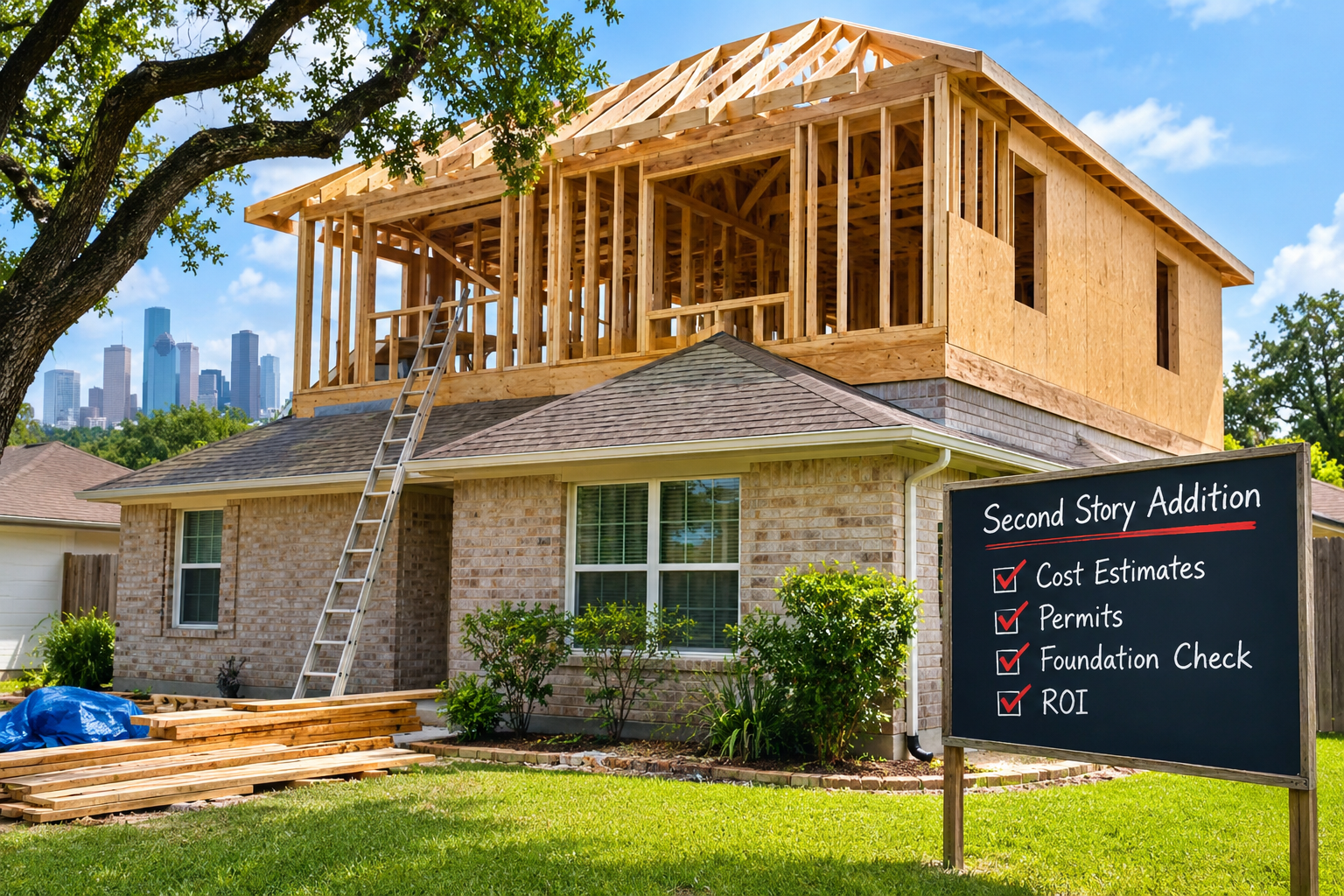
Running out of elbow room in your Houston home puts you at a classic real estate crossroads. You love your neighborhood—maybe you are tucked into a quiet street in Meyerland, enjoying the mature oaks in Oak Forest, or established near Bellaire—and your kids are settled into their schools. Yet your single-story ranch house feels tighter every single year. When you look at your backyard, building outward eats up the green space your family actually uses, or worse, runs straight into strict city setback rules and impervious cover limits. That leaves one obvious direction: building up.
Before you call an architect or start picking out upstairs flooring, you need a realistic picture of the numbers. Adding a second story in the Greater Houston area is one of the most complex residential construction projects you can undertake. Unlike slapping a coat of paint on the living room or remodeling a kitchen, popping the top off a house involves heavy structural engineering, Gulf Coast windstorm compliance, and navigating local soil conditions that love to shift. For many homeowners who realize the math, timeline, and dust simply aren't worth the headache, working with Cash Home Buyers Houston becomes a much cleaner path to moving into a larger home without living through a year-long construction zone.
If you are determined to stay put and expand vertically, knowing where every dollar goes will protect your wallet from nasty surprises. Let’s break down the real costs, hidden Texas-specific variables, and financial trade-offs of adding a second floor to a Houston home.
What Does a Second-Story Addition Cost in Houston?
Across the Greater Houston metro area, adding a second story typically runs between $150 and $350+ per square foot, depending on the scope of work, structural requirements, and finish level. Because Houston’s labor rates sit slightly below the national average while specialized engineering and hurricane-grade framing demands push costs back up, total project budgets vary wildly.
Most Houston homeowners spend between $175,000 and $500,000+ for a second-story expansion, though smaller bonus rooms over an existing garage sit on the lower end of that spectrum.
| Addition Scope | Estimated Size | Typical Houston Cost Range | Best Use Case |
|---|---|---|---|
| Bonus Room Over Garage | 400–600 sq. ft. | $90,000–$160,000 | Game room, home office, or guest suite |
| Partial Second Story | 600–1,000 sq. ft. | $125,000–$275,000 | Adding two bedrooms and a shared bath |
| Full Second-Story Pop-Top | 1,200–2,000+ sq. ft. | $300,000–$600,000 | Doubling a mid-century ranch footprint |
Several core components eat up the bulk of your construction budget:
Demolition and Roof Removal ($15,000 – $35,000): Crews must strip off your existing roof, trusses, and ceiling framing while protecting your downstairs belongings from sudden Texas downpours.
Structural Framing and Subflooring ($45,000 – $110,000): Building the new walls, floor joists, and roof structure requires heavy lumber, steel beams, and engineered trusses built to withstand Gulf Coast wind loads.
Interior Staircase Installation ($10,000 – $25,000): You have to sacrifice roughly 40 to 60 square feet of your first floor to carve out a stairwell, frame the opening, and install treads, risers, and railings.
MEP Systems—Mechanical, Electrical, and Plumbing ($35,000 – $85,000): Extending drain stacks through existing downstairs walls, upgrading your electrical panel to 200 amps, and installing a dedicated upstairs HVAC zone represent major line items.
Exterior Siding, Windows, and New Roof ($30,000 – $75,000): Matching vintage brick or replacing all exterior cladding so the house looks cohesive—plus installing a brand-new roof over the entire structure—adds substantial cost.
Interior Finishes ($50,000 – $150,000+): Drywall, insulation, flooring, trim, cabinetry, and bathroom tile are where your personal taste can either keep the budget grounded or send it into the stratosphere.
Houston-Specific Factors That Drive Up Your Budget
Building up in Houston isn't the same as building up in Dallas, Austin, or Denver. Our local geography, climate, and municipal rules introduce unique engineering hurdles that directly impact your bottom line.
Expansive Clay Soil and Slab-on-Grade Foundations
Most single-story homes built in Houston between the 1950s and 1990s sit on post-tensioned or rebar-reinforced concrete slabs poured directly over reactive Gulf Coast clay. That clay swells when saturated during hurricane season and shrinks during August droughts. Crucially, your original builder engineered that slab to carry the weight of a single-story house—not two.
Before a single wall goes up, a licensed structural engineer must inspect your foundation and soil load capacity. In roughly 70% to 80% of full second-story additions in Houston, the existing slab cannot handle the extra dead and live loads without reinforcement. Adding interior and exterior concrete piers, underpinning perimeter beams, or pouring new grade beams can easily add $15,000 to $45,000 to your project before vertical framing even begins.
Hurricane Windstorm Codes and Floodplain Rules
Houston sits inside the Texas Department of Insurance (TDI) windstorm region, and the City of Houston enforces strict International Residential Code (IRC) wind-bracing standards. Adding a second story increases the sail area of your house—meaning high winds push harder against a taller wall. Contractors must install continuous load-path hardware, hurricane straps, shear walls, and impact-rated or windstorm-certified windows, pushing material and labor costs higher than inland markets.
If your home sits inside a 100-year or 500-year floodplain—common in neighborhoods near Brays Bayou, White Oak Bayou, or Buffalo Bayou—you also trigger FEMA’s 50% Rule. Under this regulation, if the cost of your addition and remodel exceeds 50% of the market value of your structure (excluding land value), you are legally required to elevate the entire existing house above the Base Flood Elevation. For a slab-on-grade home, lifting the entire house is financially prohibitive and effectively stops a second-story addition dead in its tracks.
City of Houston Permitting and Deed Restrictions
Navigating the City of Houston Permitting Center takes patience and precision. Structural additions require stamped architectural and engineering drawings, energy code compliance documentation (REScheck), and multiple staged inspections. Plan review and permit fees generally run between $2,500 and $6,000 depending on project valuation.
Beyond city hall, check your neighborhood deed restrictions or HOA covenants. Many older Houston subdivisions—including sections of Memorial, West University Place, and River Oaks—enforce strict height caps, lot-coverage ratios, and "garagescape" rules. Even neighborhoods without an active HOA often have civic clubs that vigorously enforce historic deed restrictions regarding building height and side-yard setbacks.
Partial vs. Full Second-Story Addition: Which Makes Sense?
You don't always have to double the size of your house to solve your space crunch. Choosing between a partial build and a full pop-top comes down to your layout, foundation strength, and budget.
Partial Second-Story Addition
A partial addition places new square footage over one specific wing of your home—most commonly above an attached garage or over the bedroom wing. Because a garage already has deep perimeter footings and minimal interior plumbing below it, building a 500-square-foot suite above the garage is usually the most cost-effective way to gain vertical space. You avoid tearing the roof off your main living areas, which cuts weatherproofing risks and sometimes allows your family to remain in the house during construction.
Full Second-Story Addition
A full addition strips the entire roof off your home and builds a complete second floor matching your ground-level footprint. While the cost per square foot is slightly more efficient at scale, the total outlay is massive. You will almost certainly need to move out for six to twelve months while crews tear open the ceiling, rewire mechanical systems, and reinforce the foundation. However, a full pop-top lets you completely reimagine your home’s architecture, transforming a dated 1,600-square-foot ranch into a cohesive 3,200-square-foot two-story residence with modern ceiling heights and better curb appeal.
Hidden Costs Homeowners Often Overlook
Even well-researched renovation budgets get derailed by soft costs and indirect expenses that don't show up on a rough square-footage estimate. Make sure your contingency fund—ideally 15% to 20% of total construction costs—accounts for these realities:
Temporary Housing and Storage ($12,000 – $30,000+): Living in a house without a roof during a Houston summer or hurricane season isn't realistic. Renting a furnished apartment or short-term rental nearby for six to nine months, plus climate-controlled storage for your furniture, adds up fast.
Architectural and Structural Engineering Fees (8% – 15% of build cost): Quality plans aren't optional. Expect to pay $15,000 to $45,000 for an architect, structural engineer, and MEP designer to draw code-compliant blueprints.
Downstairs Remodeling Fallout ($10,000 – $40,000): Cutting a new staircase into your first floor rarely leaves adjacent rooms untouched. You will likely need to patch hardwood floors, reroute downstairs AC ducts, and repaint rooms affected by structural post installations.
Higher Property Taxes and Homeowners Insurance: Harris County Appraisal District (HCAD) automatically pulls building permits. Once your addition passes final inspection, your appraised value—and your annual property tax bill—will jump significantly. Your homeowners insurance premium will also increase to cover the higher replacement cost.
Building Up vs. Selling and Moving: Doing the ROI Math
Before signing a six-figure construction contract, run a cold, objective return-on-investment check on your neighborhood. According to national remodeling benchmarks like the JLC Cost vs. Value Report, major structural additions rarely recoup 100% of their construction cost immediately upon resale—typically returning between 50% and 65% in added market value right away.
In high-appreciation Inner Loop neighborhoods like The Heights, Montrose, or Bellaire, where dirt alone commands $500,000 to $1,000,000+, spending $350,000 to add 1,500 square feet often makes total financial sense. You create a home worth $1.2 million+ without paying realtor commissions, title fees, and moving costs twice.
Conversely, if you live in an outer-ring subdivision where comparable two-story homes already sell for $375,000 to $425,000, sinking $300,000 into a $250,000 single-story house will price you well above the neighborhood ceiling. You risk over-improving for your block, meaning you won't recover that capital when you eventually sell. Always pull recent comparable sales for existing two-story homes within a half-mile radius before committing to a build.
Frequently Asked Questions (FAQ)
How long does it take to add a second story in Houston?
From initial architectural drawings and City of Houston permitting to final walkthrough, expect the entire process to take 9 to 15 months. Design and engineering typically take 2 to 3 months, permitting takes 1 to 3 months depending on city backlogs, and active construction lasts 6 to 9 months. Heavy rainstorms or supply delays for custom windows and trusses can push timelines out further.
Can you live in your house while adding a second story?
For a small bonus room built strictly over an attached garage, staying in the main house is sometimes possible if your contractor builds an insulated temporary dust wall. For a partial or full second-story addition over your main living space, moving out is strongly recommended. Once crews remove the roof and cut into ceilings for plumbing, electrical, and staircase framing, noise, dust, exposed framing, and water intrusion risks make daily life unsafe and miserable.
Does adding a second story require foundation work in Texas?
Almost always, yes. Most single-story Texas homes sit on concrete slabs designed only for single-level structural loads. Because Houston sits on expansive clay soil that shifts with moisture changes, structural engineers usually require helical piers, drilled concrete piers, or thickened interior footings to transfer the weight of the new second floor safely into stable soil layers.
Is it cheaper to build up or build out in Houston?
On a strict cost-per-square-foot basis, building out is generally cheaper—typically running $120 to $220 per square foot compared to $150 to $350+ per square foot for building up. Building out avoids roof demolition, complex staircase framing, and heavy upper-level structural reinforcement. However, if your Houston lot has limited yard space, strict impervious cover limits, or tight setback lines, building up is often your only legal way to expand.
Will adding a second story increase my Houston property taxes?
Yes. When your contractor pulls a building permit with the City of Houston or Harris County, that data is shared with the local appraisal district. Once construction wraps up, the appraisal district will reassess your property based on the newly added square footage and updated condition, increasing your annual property tax liability—though your existing Texas homestead exemption cap (10% annual assessed value cap) applies only to existing structure value, not new improvements.

How Absolute Properties Helps Houston Sellers
Absolute Properties makes it easy for Houston homeowners to sell fast - even when facing challenges like financial difficulties, inherited properties, troublesome tenants, or repairs.
If you’re thinking, “I need to sell my house fast in Houston…” We buy houses in Houston in any situation or condition!
As-is, fast cash offers with clear terms
Many closing costs covered; no realtor commissions in most cases
You choose the closing date (as little as 7 days, case-dependent)
Coordination with experienced title company for a compliant sale process
Call or text: (713) 230-8059
Email address: info@absolutepropertieshtx.com
Share your street address and timeline for a free consultation and a straightforward number no pressure.
Know someone else who needs to sell? We Also Pay a $1000 Referral Fee!
Helpful Houston Blog Articles
How To Sell Your House in Houston Without Sinking Any More Money Into It
6 Tips For First Time Home Sellers in Houston
Hiring an Agent Vs. A Direct Sale to Absolute Properties When Selling Your House in Houston
Who Pays Closing Costs in Texas
The True Costs of An FSBO Listing for Houston Investors
What To Do With Your Expired Listing in Houston
Also check out our Free Guides & Education & FAQ for more education on how to sell your house for cash quickly to a local home buyer.