Reviewed by Mark Lee
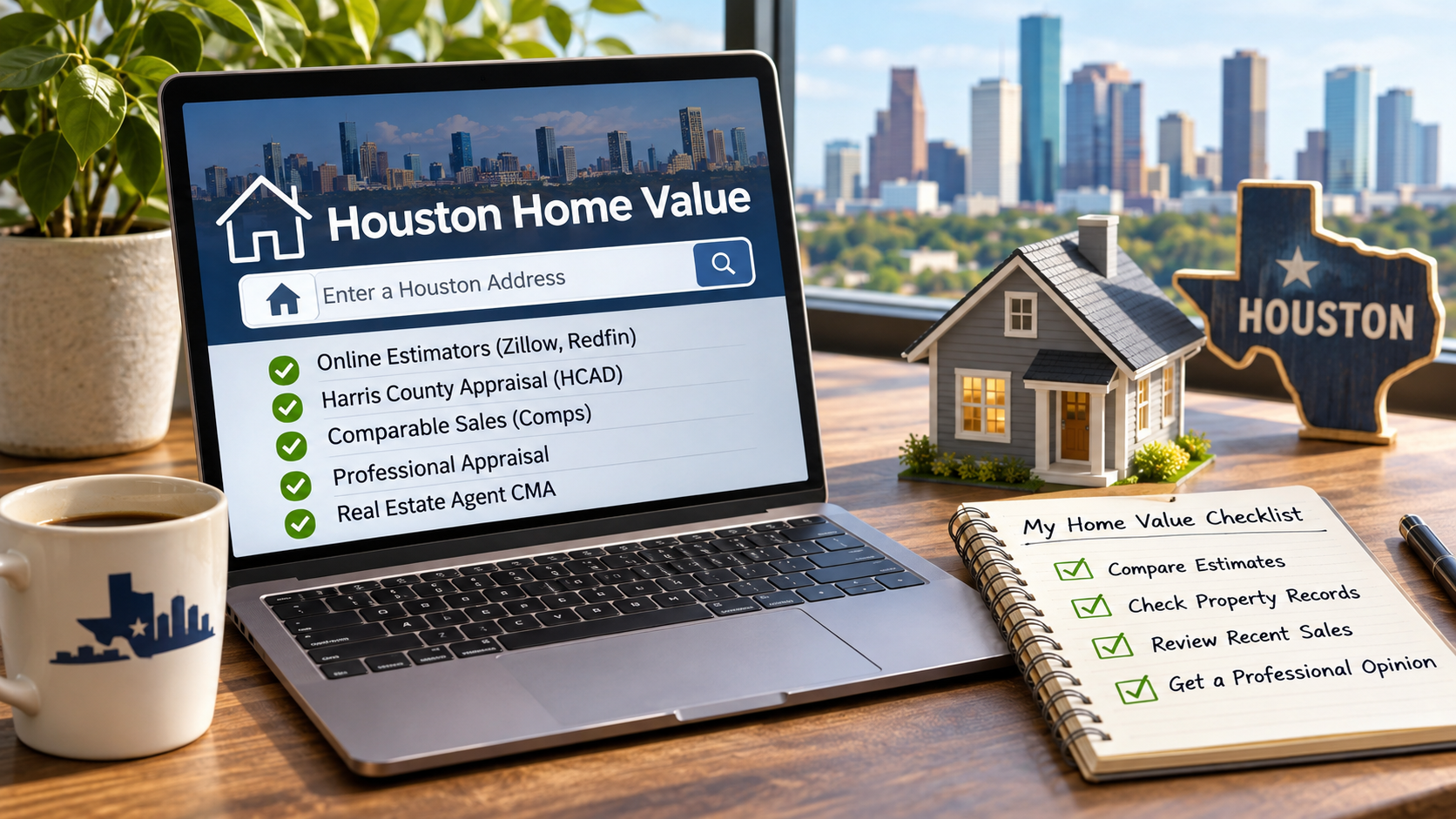
Figuring out what a home is worth in the sprawling Houston real estate market can feel like trying to guess the exact number of jellybeans in a giant jar. Whether you are getting ready to list your property, preparing to fight a Harris Central Appraisal District (HCAD) tax hike, or looking to Sell my house fast Houston, you need reliable numbers.
The good news is that you have plenty of options. The bad news is that not all valuation tools are created equal. Some methods give you a hyper-accurate picture based on recent neighborhood sales, while others rely on automated algorithms that might miss the fact that you just gutted your kitchen or that your foundation needs major work.
Let’s break down the 10 most common ways to look up a house's value in the Greater Houston area, ranked and evaluated for trustworthiness.
1. Automated Valuation Models (AVMs): The Real Estate Aggregators
When most people want to find out what a home is worth, they automatically pull up consumer-facing portals like Zillow, Redfin, or Realtor.com. These platforms use Automated Valuation Models (AVMs) to churn out instant estimates.
Zillow’s Zestimate and Redfin Estimates
How it works: These algorithms pull public records, tax assessments, and user-submitted data, feeding them into machine-learning models that crunch recent local sales data.
Trustworthiness: Moderate to Low. While these tools are fantastic for a quick, birds-eye view of neighborhood trends, they have blind spots. In dynamic Houston markets—where a flooded street can drastically alter property values from one block to the next—AVMs often stumble. They cannot physically see whether your interior features builder-grade 1990s oak cabinets or luxury quartz countertops.
2. County Appraisal Districts (HCAD and Surrounding CADs)
If you own property in Texas, you are likely intimately familiar with your local appraisal district. In Harris County, that is HCAD (Harris Central Appraisal District), though you might also be dealing with Fort Bend CAD, Montgomery CAD, or Brazoria CAD depending on where your property sits.
Local Tax Assessor Records
How it works: You can hop online, punch in a street address, and pull up the county’s official appraised value, land value breakdown, and building history.
Trustworthiness: High for tax purposes, but often Low for current market value. Texas is a non-disclosure state, meaning sales prices are not publicly recorded by the state government. County appraisal districts rely on mass appraisal techniques and limited data sets. While their land value estimates are usually solid, their total market valuation often lags behind reality—especially in rapidly appreciating or volatile neighborhoods.
3. Local Multiple Listing Service (MLS) via HAR.com
Houston boasts one of the most robust and user-friendly real estate portals in the country through the Houston Association of Realtors (HAR.com).
HAR Community and Market Reports
How it works: HAR.com aggregates live data straight from licensed real estate agents. You can check recent neighborhood sales, pending listings, and historical price drops.
Trustworthiness: Extremely High. Because HAR pulls data directly from active professional transactions rather than scraped estimates, it represents the gold standard of raw market data. If you want to see what homes actually sold for on your specific street over the last three months, this is where you find it.
4. Comparative Market Analysis (CMA) From a Local Realtor
Instead of trusting an algorithm, you can ask a licensed real estate professional to run a Comparative Market Analysis (CMA) for you.
Agent-Driven CMAs
How it works: A local agent hand-picks recently sold properties (comps) that match your home’s exact square footage, age, school district, and condition, making mathematical adjustments for differences.
Trustworthiness: Very High. A good Houston real estate expert understands micro-market nuances—like whether being zoned to a top-tier elementary school in Katy adds a 15% premium to your home value. Because they evaluate the property's actual condition, a CMA bridges the gap between raw data and physical reality.
5. Professional Real Estate Appraisers
When you refinance a mortgage or buy a home, your lender requires a licensed, independent appraiser to put a definitive dollar amount on the property.
Certified Appraisals
How it works: A state-certified appraiser visits the property, walks through every room, measures dimensions, evaluates structural integrity, and compiles a comprehensive formal report using localized sales comps.
Trustworthiness: The Highest. This is the closest thing to an objective, legally binding valuation you can get. However, it comes with a catch: professional appraisals usually cost several hundred dollars out of pocket and take time to schedule.
6. Neighborhood Price-Per-Square-Foot Calculations
A quick-and-dirty method many DIY investors and homeowners use is calculating the average price per square foot in a tight subdivision.
Manual Math Using Recent Sales
How it works: Take the sales prices of three to five comparable homes nearby, divide each by its total square footage, find the average, and multiply it by your home's square footage.
Trustworthiness: Low to Moderate. This method assumes that every square foot holds equal value, which is rarely true. A finished garage apartment or a brand-new primary bathroom suite skews square-foot pricing significantly. It is a great sanity check, but a terrible standalone valuation method.
7. Cash Home Buyer and Investor Valuations
If you are looking to sell quickly without making repairs, you can request an all-cash offer from local real estate investors or home-buying companies.
Investor As-Is Valuation Offers
How it works: Companies evaluate your property based on its After Repair Value (ARV)—what the home will be worth after a full renovation—minus the estimated cost of repairs and a profit margin.
Trustworthiness: High for its specific purpose, though lower if you are looking for retail market value. Cash buyers are transparent about discounting repairs and convenience, giving you a realistic baseline of what a fast, hassle-free liquidity event looks like.
8. Construction and Replacement Cost Calculators
Sometimes you need to know what a house is worth based purely on what it would cost to rebuild it from scratch.
The Cost Approach Method
How it works: This method calculates the current cost of building materials and labor to replace the structure, adds the estimated value of the vacant land, and subtracts physical depreciation.
Trustworthiness: Moderate. While essential for insurance policies and brand-new construction, it often fails in older, established urban neighborhoods (like Houston’s Inner Loop or the Heights) where land value vastly outweighs the physical structure resting on top of it.
9. Mortgage Lender and Bank Automated Tools
Major financial institutions like Chase, Bank of America, and local credit unions offer proprietary home valuation calculators on their websites.
Bank-Issued Property Explorers
How it works: These tools feed user address data into backend valuation models provided by credit bureaus or title companies to gauge equity for home equity lines of credit (HELOCs).
Trustworthiness: Moderate. These models lean heavily on conservative lending data and public tax records. They tend to err on the side of caution, meaning their estimates are frequently lower than actual market value to protect the bank's risk exposure.
10. Neighborhood Word-of-Mouth and Local Real Estate Groups
Finally, many homeowners turn to local Facebook groups, neighborhood listservs, or casual chats with neighbors who recently sold.
Peer-to-Peer Community Insights
How it works: Asking locals what homes on your block are trading for.
Trustworthiness: Low. While neighbors can provide great color commentary on local school changes or neighborhood vibe, human memory is notoriously biased. People tend to remember the record-breaking high sales price of a home down the street while forgetting the fixer-upper that sold for far less.
Frequently Asked Questions
Are online home value estimators accurate in Texas?
Generally, no. Because Texas is a non-disclosure state, automated sites like Zillow lack access to exact closing prices, forcing them to rely on public estimates and historical listing data that can miss the mark by thousands of dollars.
Can I use my county appraisal district value to sell my house?
You can look at it as a reference point, but buyers will not care what HCAD says your home is worth. Appraisal districts under- or over-assess properties routinely for tax administration, whereas buyers pay what the open market dictates.
How often should I check my home's value?
If you are actively monitoring your equity or planning a move, checking once or twice a year using a blend of HAR.com data and a local agent consultation gives you the most accurate pulse of the market.
What is the most reliable way to find my home's value?
A combination of recent localized sales data from HAR.com and a professional Comparative Market Analysis (CMA) performed by an experienced real estate expert yields the most reliable, actionable valuation.

How Absolute Properties Helps Houston Sellers
Absolute Properties makes it easy for Houston homeowners to sell fast - even when facing challenges like financial difficulties, inherited properties, troublesome tenants, or repairs.
If you’re thinking, “I need to sell my house fast in Houston…” We buy houses in Houston in any situation or condition!
As-is, fast cash offers with clear terms
Many closing costs covered; no realtor commissions in most cases
You choose the closing date (as little as 7 days, case-dependent)
Coordination with experienced title company for a compliant sale process
Call or text: (713) 230-8059
Email address: info@absolutepropertieshtx.com
Share your street address and timeline for a free consultation and a straightforward number no pressure.
Know someone else who needs to sell? We Also Pay a $1000 Referral Fee!
Helpful Houston Blog Articles
How To Sell Your House in Houston Without Sinking Any More Money Into It
6 Tips For First Time Home Sellers in Houston
Hiring an Agent Vs. A Direct Sale to Absolute Properties When Selling Your House in Houston
Who Pays Closing Costs in Texas
The True Costs of An FSBO Listing for Houston Investors
What To Do With Your Expired Listing in Houston
Also check out our Free Guides & Education & FAQ for more education on how to sell your house for cash quickly to a local home buyer.